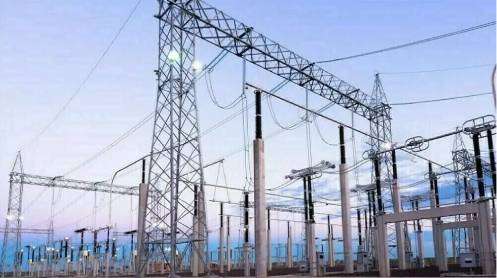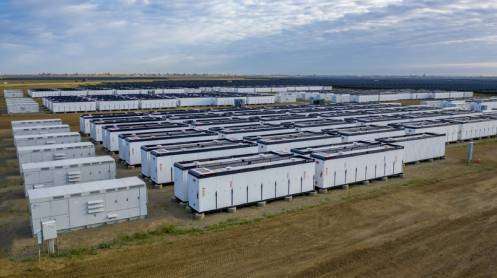
ISLAMABAD: The government is advancing plans to deploy large, utility-scale Battery Energy Storage Systems (BESS) to stabilise the national grid, which is increasingly challenged by frequency fluctuations due to the rapid addition of intermittent renewable energy sources.
In a written reply to the National Assembly on Friday, Power Minister Sardar Awais Leghari said the government is promoting private-sector investment in grid-scale BESS to manage renewable intermittency, improve demand optimisation, and enhance overall system stability.
Responding to questions from MNAs, the minister also confirmed a policy shift away from imported LNG, driven by high capacity payments, rising indigenous renewable generation, and stagnant demand growth.
Mr Leghari said Pakistan’s clean energy share had reached 46% by September 2025, surpassing the government’s 40% target for 2025. Current renewable capacity includes 60 private-sector projects totalling 4,753MW — comprising 680MW solar, 1,937MW run-of-river hydro, 1,845MW wind, and 291MW bagasse cogeneration. Public-sector hydropower contributes an additional 9,619MW, while KE operates 100MW of solar.
He said net-metering-based solar PV had injected 6,390MW into the system, further increasing the clean energy footprint.
The minister noted that the government had finalised an initial 800MW quota for the Competitive Trading Bilateral Contract Market (CTBCM), enabling large consumers to procure renewable power directly from producers through wheeling at around Rs13 per unit.
Highlighting the shift towards least-cost indigenous energy, he said reliance on imported LNG had “comparatively reduced” as the government prioritises Thar coal, hydropower, solar, wind, and bagasse.
He added that the government is actively promoting solar adoption across residential, commercial, and industrial sectors under a regulated net-metering framework that ensures safe installation and quality certification of solar and wind systems up to 1MW.
To another question, Mr Leghari clarified that load management is now based solely on ATC losses, and not due to any nationwide generation shortfall.
Story by Khaleeq Kiani