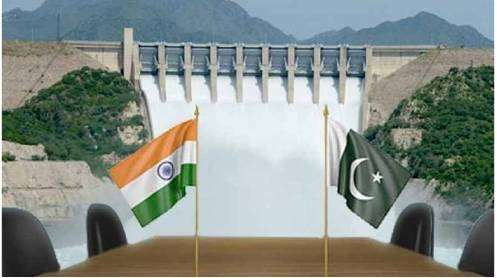
ISLAMABAD: Following Pakistan’s recent victory over India in a short-term military conflict, experts have warned that New Delhi has launched what they describe as a “water war” against Pakistan by manipulating water releases and storage at its dams, causing damage to Pakistani agriculture.
Water experts and former officials have urged the government to approach the International Court of Justice (ICJ) to seek sanctions against India for violating its international obligations under the Indus Waters Treaty (IWT). They argue that India’s actions amount to a breach of the treaty, which strictly governs water-sharing arrangements between the two countries.
Under the IWT, India is legally bound to share prior information with Pakistan regarding any plans to release or store water, or to construct run-of-the-river hydropower projects on rivers allocated to Pakistan, including the Chenab River.
Pakistan and India have a long history of disputes over water rights. The latest legal confrontation emerged after India announced the suspension of the Indus Waters Treaty, a move that led Pakistan to seek international arbitration. Subsequently, international arbitrators upheld Pakistan’s stance, ruling that the treaty cannot be unilaterally suspended and remains fully intact and binding on both countries.
Former Indus Water Commissioner Jamaat Ali Shah told The Express Tribune that India cannot take unilateral actions under the treaty and must share all relevant hydrological and project-related data with Pakistan. He pointed out that India is currently constructing a run-of-the-river hydropower project on the Chenab River, noting that a panel of India’s environment ministry has approved the 260-megawatt Dulhasti Stage-II project in the Kishtwar district of Indian-occupied Jammu and Kashmir.
“India is bound to share information with Pakistan relating to any project, including run-of-the-river schemes, under the Indus Waters Treaty,” Shah said, adding that Pakistan should pursue international arbitration and now escalate the matter to the ICJ.
He stressed that even if such projects do not immediately reduce water inflows, the obligation to share information remains mandatory. Shah also recalled that despite India’s announcement to suspend the treaty, both a neutral expert and the Court of Arbitration ruled in Pakistan’s favour and confirmed that treaty-related proceedings would continue.
“Pakistan should now approach the ICJ,” he said, adding that a favourable ruling could expose India to international sanctions similar to those imposed on Iran. He noted that European countries have invested more than $40 billion in India and that sanctions could lead to a suspension of foreign investment.
Referring to possible mediation, Shah recalled that former US president Donald Trump had expressed willingness to help resolve the water dispute. However, he emphasised that Pakistan should simultaneously pursue both legal and diplomatic channels.
Pakistan has previously warned that, as a last resort, it could target dams being built by India on rivers allocated to Pakistan in order to protect its water rights.
Impact on agriculture
The Ministry of Water Resources said the Punjab Irrigation Department is closely monitoring Chenab River flows at Marala, excluding flows from Jammu and Manawar Tawi, and regularly sharing data with the office of the Pakistan Commissioner for Indus Waters.
According to the ministry, Chenab flows have stabilised recently after a phase of extreme volatility. Hydrological data shows an extraordinary reduction in river discharge between December 10 and December 16, 2025, when flows dropped to as low as 870 cusecs — far below the historical 10-year minimum range of 4,018 to 4,406 cusecs.
Satellite imagery from December 8 and December 13, 2025, revealed a sharp decline followed by a sudden increase in the surface area of the Baglihar reservoir, indicating that India had first emptied and then refilled the dam.
Following these developments, Pakistan’s Commissioner for Indus Waters formally raised the issue with his Indian counterpart and sought detailed data under the treaty framework.
Experts believe these actions were deliberately aimed at harming Pakistani crops. Muhammad Altaf, a farmer from South Punjab, said canal water supplies had become unpredictable. “Sometimes we do not receive water for one or two weeks without any intimation,” he said.
Chairman Kisan Ittehad Khalid Hussain Bath said India had earlier released excess water during floods, damaging crops, and was now restricting flows when irrigation was critically needed. He warned that while Balochistan may be less affected due to limited canal coverage, Punjab and Sindh could face severe agricultural losses. He urged the government to intensify diplomatic and legal efforts to compel India to comply with the Indus Waters Treaty.
Story by Zafar Bhutta