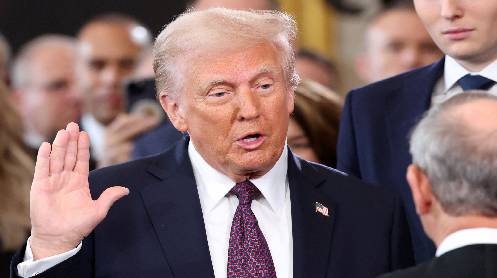
US President Donald Trump said on Tuesday that Venezuela’s interim government will deliver between 30 million and 50 million barrels of oil to the United States, with the proceeds to be managed under his authority as president.
In a social media post, Trump said the oil—described as “sanctioned oil”—would be sold at market prices and that the revenue would be controlled by him to ensure it is used “to benefit the people of Venezuela and the United States.” He added that US Energy Secretary Chris Wright would oversee the execution of the arrangement, with crude taken from ships and delivered directly to US ports.
The announcement signals growing pressure by Washington on Caracas to open its oil sector to US companies. Trump has previously demanded that Venezuela grant the US and private firms “total access” to its oil industry, warning of further military action if it failed to comply.
Venezuela currently has millions of barrels of oil stored in tanks and loaded on vessels that it has been unable to export due to a US-imposed blockade on oil shipments introduced in mid-December. The restrictions followed escalating tensions between Washington and the government of President Nicolas Maduro, which culminated in a recent US military operation in the country. Venezuelan officials have accused the United States of attempting to seize the nation’s vast oil resources.
According to sources cited by Reuters, supplying the stranded crude to the US may initially require diverting cargoes originally destined for China, Venezuela’s largest oil buyer over the past decade, particularly after US sanctions tightened in 2020.
“This is something Trump wants done quickly so he can present it as a major win,” an oil industry source said.
Neither the Venezuelan government nor state oil company Petróleos de Venezuela (PDVSA) commented on the announcement.
Following Trump’s remarks, US crude prices fell more than 1.5 per cent on expectations that increased Venezuelan supply would reach the market. At present, exports of Venezuelan oil to the US are handled exclusively by Chevron—PDVSA’s main joint venture partner—under a special US authorisation. Chevron has been shipping between 100,000 and 150,000 barrels per day to US refineries despite the broader export blockade.
It remains unclear whether Venezuela will have access to any of the proceeds from the sales. Under existing sanctions, PDVSA is largely cut off from the international financial system, with frozen accounts and restrictions on dollar transactions.
Venezuela has recently been selling its flagship heavy crude, Merey, at about $22 per barrel below Brent prices for delivery at Venezuelan ports, valuing the proposed deal at up to $1.9 billion.
Discussions between US and Venezuelan officials this week reportedly included options such as auctioning cargoes to US buyers and issuing licences to PDVSA’s partners—moves that could enable renewed supply contracts. Past licences have allowed companies such as Chevron, India’s Reliance, China’s CNPC, and Europe’s Eni and Repsol to lift Venezuelan crude.
Some of these firms have already begun preparations to resume receiving Venezuelan cargoes, sources said. Talks have also touched on the possibility of using Venezuelan oil to replenish the US Strategic Petroleum Reserve, though Trump did not mention this.
US Interior Secretary Doug Burgum welcomed the prospect of increased Venezuelan heavy crude flows to the US Gulf Coast, saying it would support jobs, stabilise fuel prices and offer Venezuela a chance to rebuild its economy.
US Gulf Coast refineries are well suited to processing Venezuela’s heavy crude and were importing around 500,000 barrels per day before energy sanctions were first imposed. PDVSA has already reduced production due to storage constraints, and further cuts may be unavoidable without an outlet for exports, sources warned.
Oil traders reacted swiftly, with differentials for heavy crude grades in the US Gulf easing by about 50 cents per barrel on expectations of additional Venezuelan supply.
Story by Reuters | AFP