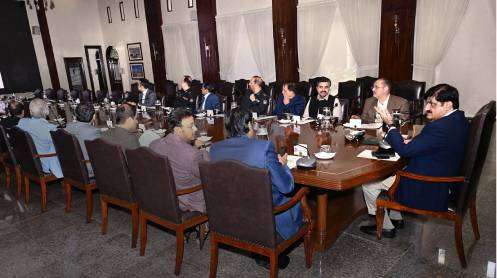
Mr. Atif Ikram Sheikh, President FPCCI, has made a fervent appeal to the federal government to immediately declare an industrial emergency in Pakistan; warning that the country’s manufacturing base is teetering on the brink of a systemic and irreversible collapse. He reiterated that FPCCI rejects incremental package as no industry received electricity bill at PKR. 22 per unit and they continue to receive the bills at PKR. 34 – 35 per unit.
FPCCI President Mr. Atif Ikram Sheikh and United Business Group (UBG) Patron-in-Chief Mr. S. M. Tanveer have asserted that a lethal combination of regionally-uncompetitive energy tariffs; exorbitant interest rates and a restrictive taxation regime has made it nearly impossible for local industries to compete in the global marketplace. They also highlighted the plight of stagnating real estate sector as 40 allied industries are also suffering along with it.
Mr. Atif Ikram Sheikh maintained that, on excessive income tax rates, FPCCI demands the reduction of income tax on industry from 39% to 20% and it advocates the maximum income tax on the salaried class at 15%. Whereas, tariff of gas for industries should be brought down to PKR. 2,400 / MMBTU from the current PKR. 3,900 / MMBTU for export competitiveness.
Mr. Atif Ikram Sheikh highlighted the alarming disparity in utility costs – noting that Pakistani exporters are currently burdened with electricity tariff of 12.5 cents per unit; while regional rivals in India, Bangladesh and Vietnam are operating at significantly lower rates of 6 to 9 cents – who are the major competitors of Pakistani products in the export markets.
Mr. Atif Ikram Sheikh further argued that this gap has triggered a rapid process of de-industrialization; leading to the closure of hundreds of units and a mass exodus of capital to more business-friendly countries. Therefore, the industry can no longer sustain the cross-subsidy burden – which is effectively a hidden tax used to subsidize other sectors at the cost of national productivity.
Mr. S. M. Tanveer, Patron-in-Chief, UBG, pointed out that the textile sector – the backbone of Pakistan’s exports – is facing an existential crisis, with over 100 mills already forced to cease operations. He criticized the government’s unfruitful reliance on high interest rates to curb inflation; noting that the resulting liquidity crunch has stifled private-sector credit and halted industrial expansion.
Mr. S. M. Tanveer stressed that FPCCI demands to reduce the key policy rate from the current 10.5% to 9% in the upcoming Monetary Policy Committee (MPC) meeting of January 26 – and, gradually, further reduce it to 6% in the subsequent 3 MPC meetings.
S. M. Tanveer emphasized that without a drastic reduction in the policy rate, special tariff for export-oriented industries and a downward rationalization of taxes, the country would fail to meet its export targets.
S. M. Tanveer proposed a multi-pronged recovery framework and also urged the Special Investment Facilitation Council (SIFC) to intervene. FPCCI demands include a complete shift to a take-and-pay model for independent power producers (IPPs); the immediate clearance of all pending sales tax refunds under the Export Facilitation Scheme (EFS) and the provision of a flat 9-cent power tariff for the export sector immediately – and, further reduction to 7 cents per unit for export-oriented industry by the next year.
Mr. S. M. Tanveer cautioned that if the government does not act swiftly to grant industry the first right over economic resources and fiscal incentives, the resulting unemployment and loss of foreign exchange will lead to an irreversible economic downturn.