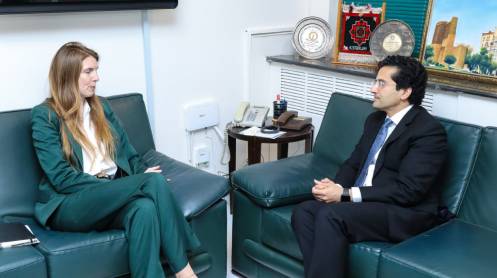
ISLAMABAD: Delegations from the World Bank and the Islamic Development Bank (IsDB) held separate meetings with Federal Minister for Power Sardar Awais Ahmed Khan Leghari on Monday to review ongoing reforms in Pakistan’s power sector, with discussions centred on sustainability, efficiency and long-term financial viability.
According to an official statement, the World Bank delegation was led by Ousmane Dione, Vice President for the Middle East, North Africa, Afghanistan and Pakistan region, while the IsDB delegation was headed by Dr Rami Ahmad, Vice President (Operations).
During the meetings, the minister briefed the delegations on key reforms across power generation, transmission and distribution. He said around 8,000 megawatts of costly and unnecessary power plants had been excluded from the Indicative Generation Capacity Expansion Plan (IGCEP), resulting in estimated savings of $17 billion for electricity consumers over the coming years.
Leghari said inefficiencies in power distribution companies were being systematically addressed, yielding improvements valued at Rs197 billion, while circular debt had been reduced by Rs780 billion. He added that imported coal-fired power plants were being converted to run on indigenous Thar coal to reduce fuel costs and strengthen energy security.
The minister said the government was working to remove transmission bottlenecks and move towards full deployment of automated metering infrastructure. He also highlighted incentive packages for industrial and agricultural consumers aimed at boosting electricity demand and rationalising tariffs.
According to the statement, captive power plants were being shifted to the national grid to enhance overall system efficiency, while tariff incentives had been introduced to promote the adoption of electric vehicles. Net metering regulations were also under review to ensure a more equitable framework for all consumers.
On governance and market reforms, Leghari said the wholesale electricity market was being liberalised to foster competition, while a five-year national electricity plan had been institutionalised. He added that key sector entities — including the national grid company, the system operator and the Private Power and Infrastructure Board — were undergoing restructuring.
The Power Planning and Monitoring Company (PPMC), a technical arm of the Ministry of Energy, was providing analytical support and monitoring reform implementation, while digital tools were being deployed to improve consumer services and strengthen regulatory oversight.
The minister emphasised that the transition to cleaner energy sources was central to achieving long-term energy security and economic stability.
World Bank Vice President Ousmane Dione and IsDB Vice President Dr Rami Ahmad welcomed the reform measures undertaken by the government and acknowledged progress in improving efficiency and financial sustainability in the power sector. They reaffirmed their institutions’ continued engagement with Pakistan in support of energy sector development.