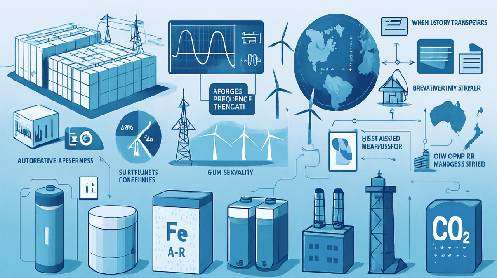
The global energy storage sector reached a historic milestone in 2025, with annual installations surpassing 100 gigawatts for the first time, despite significant policy shifts in the world’s two largest markets, China and the United States.
According to Wood Mackenzie’s latest report, “What to look for in 2026: Global Storage,” growth has continued even as China removed its requirement to pair energy storage with new renewable projects, moving instead toward market-based mechanisms that introduce revenue uncertainty. In the US, tax incentives remain intact, but supply chain restrictions are limiting the use of Chinese battery modules.
The report identifies five major trends expected to shape the global storage market in 2026.
Chinese manufacturers restructure and diversify
To maintain access to the US market, Chinese battery and storage companies are expected to announce new ownership structures in 2026, reducing their stakes to below 25% to comply with Foreign Entity of Concern (FEOC) rules. At the same time, Chinese suppliers are expanding investments into South and Southeast Asia, Europe and the Middle East to gain market share, even at the cost of lower short-term margins.
Tight supply and price stabilization ahead
Battery supply remains constrained, with shortages that emerged in late 2025 likely to persist until mid-2026. The shortfall is particularly severe for certified batteries from top-tier suppliers. Wood Mackenzie expects system prices to stabilize in the second half of 2026 as supply conditions gradually improve.
Grid-forming storage becomes essential
Grid-forming storage is shifting from a voluntary feature to a regulatory requirement in many markets as coal and gas plants retire and variable renewable energy expands. These inverter-based systems help stabilize grid voltage and frequency. The European Commission is expected to introduce a harmonized framework for grid-forming requirements in 2026. While such systems previously cost 10–15% more, the price premium is rapidly disappearing as manufacturers integrate the capability into standard products.
New storage technologies gain momentum
Lithium-ion batteries continue to dominate, but alternative technologies are scaling up. Sodium-ion, flow batteries and iron-air systems are becoming competitive for specific applications. In the US, Peak Energy is advancing a 4.75 GWh sodium-ion supply deal with Jupiter Power, while CATL plans to launch sodium-ion batteries for energy storage in 2026. In Europe, policy support such as “cap and floor” mechanisms in the UK and Italy is improving bankability for long-duration, non-lithium storage projects.
Rising demand from data centres and hybrid projects
Large data centres, driven by generative AI, are increasingly deploying battery storage to overcome grid connection delays and manage highly volatile training loads. While gas turbines remain the leading onsite power option, batteries are now the second most common choice. Developers are also pairing storage with solar and wind to reduce curtailment and protect revenues. In Australia and India, more than half of storage projects announced in 2025 were hybrid systems, a trend also accelerating in Europe amid rising negative power prices.
Regionally, the US market is expected to see a temporary slowdown in 2026–27 due to tariffs and supply chain restructuring, with growth rebounding by 2028. Europe stands out as a bright spot, with installations rising 160% in 2025. Germany leads in distributed storage, while the UK dominates utility-scale projects. In Latin America, Brazil plans a national storage auction in early 2026, and Chile is updating market rules to better reward storage for grid services.
As global installations continue to accelerate, energy storage is rapidly evolving from a backup solution into a core pillar of grid reliability and the clean energy transition.
Story by Ryan Kennedy