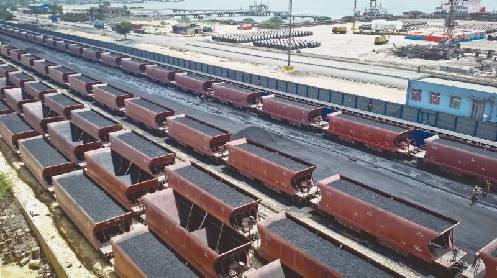
KARACHI: Pakistan’s energy transition narrative is increasingly pulling in two opposing directions, creating a policy and investment dilemma centred on Port Qasim and a Rs90 billion coal-dedicated railway line from Thar.
On one side, the government is close to completing a massive rail infrastructure project designed exclusively to transport lignite coal from the Thar Desert to Port Qasim. The stated objective is to reduce dependence on costly imported fuels by utilising domestic coal for power generation and industry. On the other, the same port is being promoted internationally as a future “Green Energy Hub,” aimed at attracting billions of dollars in foreign investment for green hydrogen, low-carbon fuels and climate-resilient maritime infrastructure.
The Ministry of Maritime Affairs has publicly committed to transforming Port Qasim into a climate-resilient industrial complex that supports sustainable development, job creation and long-term investment. However, critics argue that this vision directly conflicts with a coal-specific rail project whose financial viability depends on decades of sustained coal demand.
Infrastructure of this scale is built with a 25–30-year horizon. For the Rs90 billion rail line to recover its costs, it must remain a heavily used coal corridor for decades. Yet global shipping and energy markets are rapidly shifting towards net-zero targets, with international firms increasingly avoiding fossil fuel–dependent ports. Analysts warn that if coal demand declines sharply within the next 10–15 years, the railway may never reach its break-even point, turning into a stranded public asset.
Questions were formally sent to the Ministry of Maritime Affairs, the Port Qasim Authority (PQA) and Sindh Energy Secretary Shahab Qamar Ansari, seeking clarification on why the state is investing heavily in coal-specific infrastructure while simultaneously positioning Port Qasim to phase out fossil fuels. No response was received from the maritime ministry or the Sindh energy department by the time of filing.
Defending the project, PQA Public Relations Officer Asad Warsi said the rail link was essential for immediate energy security and cost reduction. “Pakistan’s approach to energy and industrial development is pragmatic and phased. The Thar–Port Qasim coal rail project ensures near-term energy security by transporting domestic coal efficiently, while the green maritime hub vision lays the foundation for a low-carbon future,” he said, adding that both initiatives are “complementary pillars of a single strategy.”
Energy analysts remain unconvinced. Optimus Capital Energy Analyst Agam Kumar highlighted recurring delays due to cost escalations, funding gaps and misaligned project timelines. He also pointed to social challenges linked to land acquisition, including low compensation for ancestral livelihoods, as well as environmental and health risks associated with coal mining and transport.
Coal transport by rail, he noted, increases atmospheric coal dust containing toxic elements such as lead, arsenic and mercury, adding to public health and environmental costs. Additional flood-resilient drainage requirements along the rail corridor further inflate costs and heighten delay risks.
Taken together, rising costs, environmental concerns and shifting global climate policies underscore a deeper contradiction in Pakistan’s energy planning. With Port Qasim being rebranded as a climate-resilient gateway and international finance steadily moving away from coal, the Rs90 billion Thar coal rail project risks becoming an expensive “ghost track”—a symbol of planning caught between an energy past and an uncertain green future.
Story by Shazia Tasneem Farooqi