ISLAMABAD: Federal Minister for Planning and Development Ahsan Iqbal has revealed that Pakistan’s poverty rate has increased significantly under the 2024–25 estimates, with national poverty rising from 21.9 percent to 28.9 percent over the past seven years.
Launching the Poverty and Inequality Estimates 2024–25 on Friday, the minister stated that rural poverty surged from 28.2 percent to 36.2 percent, while urban poverty climbed from 11 percent to 17.4 percent during the same period.
“Poverty and economic inequality have increased over the last seven years due to irresponsibility and inconsistent economic policies,” he said, adding that income inequality has also widened between 2018-19 and 2024-25 across all provinces.
Provincial Poverty Trends
According to the minister, poverty levels have increased across the country:
- Punjab: 28.4% to 32%
- Sindh: 29.7% to 35.9%
- Khyber Pakhtunkhwa: 24.8% to 29.4%
- Balochistan: 21% to 26.5%
He noted that although Balochistan started from a lower base, it also witnessed a considerable rise.
Economic Shocks and Climate Impacts
The minister described the period between FY2019 and FY2025 as exceptionally challenging, citing a combination of global and domestic shocks. He said the COVID-19 pandemic triggered a sharp contraction in economic activity, followed by a global commodity super-cycle that fueled inflation to multi-decade highs, eroding real incomes.
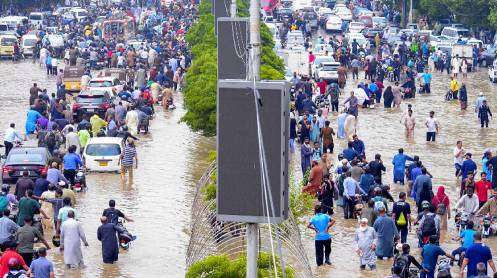
He further pointed to geopolitical tensions that disrupted global supply chains, along with severe climate shocks—particularly the devastating floods of 2022, which caused losses estimated at $30.1 billion, and additional climate-related losses of $2.9 billion in 2025. These events significantly affected livelihoods, agricultural output, and infrastructure, increasing poverty risks nationwide.
Development Spending and Provincial Responsibility
Ahsan Iqbal highlighted structural issues in development financing. He noted that in 2018, the total development budget stood at Rs4,000 billion, equally divided between the federal and provincial governments. However, under the 2024–25 framework, the federal development budget has shrunk to Rs1,000 billion, while provincial allocations have increased to Rs3,000 billion.
“The provinces now have three times more development budget than the federation,” he said, adding that while the federal government follows a resource distribution formula, provinces lack structured mechanisms to allocate funds at district and grassroots levels.
He also observed that Public Sector Development Programme (PSDP) allocations declined from 2.8 percent to 0.9 percent of the total budget in recent years. He urged provinces to adopt comprehensive poverty-reduction strategies, emphasizing that provincial performance directly influences national poverty indicators.
Poverty, Inequality and Security Concerns
The minister warned that unequal resource distribution within provinces contributes to both poverty and instability, noting that terrorism often flourishes in districts marked by deprivation and neglect. He called for equitable development policies to ensure inclusive and sustainable growth.
Social Protection and Economic Reforms
Referring to social safety nets, he said the budget of the Benazir Income Support Programme (BISP) has been increased from Rs592 billion to Rs722 billion to assist vulnerable families. However, he acknowledged that cash transfers alone are insufficient to eradicate poverty.
“Our focus is shifting toward poverty graduation programs to help beneficiaries move beyond reliance on aid,” he stated.
Export-Led Growth and SME Development
Reiterating the government’s economic roadmap, Ahsan Iqbal stressed the need for export-led growth, competitive industries, and human capital development. He emphasized promoting Small and Medium Enterprises (SMEs) and cottage industries at district and provincial levels to unlock local potential and create employment opportunities.
“Export-led growth, quality education, and competitive human resource development can significantly reduce poverty at both national and provincial levels,” he said.
Criticism of Previous Policies
The minister attributed part of the economic downturn to the policies of the previous government led by Pakistan Tehreek-e-Insaf (PTI), accusing it of economic mismanagement and fostering political instability that compelled Pakistan to enter three programs with the International Monetary Fund (IMF).
He said strict reform measures, including subsidy reductions under IMF agreements, contributed to rising poverty levels. He also criticized the former administration for encouraging excessive imports and consumer-driven growth, noting that imports surged to $80 billion, resulting in a $50 billion trade deficit.
“Zero Poverty” Vision
Reaffirming the government’s commitment to a “Zero Poverty” vision, the minister said targeted development of high-potential districts through small industrial units and export-oriented industries would remain a key priority.
He concluded that sustainable poverty reduction requires coordinated federal and provincial efforts, export-driven growth, equitable resource distribution, and long-term structural reforms to ensure inclusive national development.
Story by Naveed Butt