LONDON: Escalating tensions in the Middle East have severely disrupted global energy supply chains after a US strike on an Iranian warship intensified the ongoing conflict, leading to a near paralysis of shipping through the strategic Strait of Hormuz for the fifth consecutive day.
The situation worsened on Wednesday after a US submarine reportedly struck an Iranian naval vessel off Sri Lanka, killing 87 sailors. In response to the escalating crisis, US President Donald Trump announced that Washington would provide insurance support and naval escorts to vessels transporting oil and gas from the Middle East in an effort to stabilize global energy markets.
Despite the assurances, major global shipping companies have refused to send vessels through the Strait of Hormuz, while leading insurers have withdrawn war-risk coverage for ships operating in the region.
According to energy market intelligence firm Kpler, tanker traffic through the critical waterway has plunged sharply since the conflict began. Vessel activity data shows that oil tanker transits are now around 90 percent lower than last week, although traffic has not come to a complete halt.
Ship-tracking data indicates that around 200 vessels, including crude oil tankers, liquefied natural gas (LNG) carriers, and cargo ships, are currently anchored in open waters near major Gulf energy exporters such as Iraq, Saudi Arabia, and Qatar. Many other ships remain outside the Strait, unable to reach regional ports.
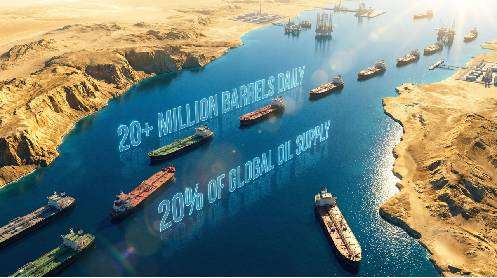
The Strait of Hormuz serves as a crucial global energy artery, facilitating the transport of nearly one-fifth of the world’s oil and LNG supplies.
In another incident highlighting the rising risks to maritime traffic, the Maltese-flagged container ship Safeen Prestige was damaged by a projectile near the northern end of the Strait, forcing its crew to abandon the vessel.
The crisis has begun to significantly disrupt oil and gas exports across the Middle East. Qatar is set to fully shut down its gas liquefaction operations, with production and exports unlikely to return to normal for at least a month. State-owned QatarEnergy has also declared force majeure on LNG shipments following attacks on its production facilities.
Meanwhile, Iraq, OPEC’s second-largest oil producer, has already cut nearly 1.5 million barrels per day (bpd)—roughly half of its production—due to storage limitations and blocked export routes. Officials warned that the country may have to shut down up to 3 million bpd, nearly its entire output, if exports remain suspended.
Saudi Arabia, the world’s largest crude exporter, has suspended operations at its 550,000 bpd Ras Tanura refinery and begun rerouting crude shipments from eastern ports to the Red Sea port of Yanbu. The refinery was targeted again on March 4 but reportedly sustained no damage.
Oil and gas production has also been partially curtailed in Israel and Iraq’s Kurdistan region, while a fire caused by falling debris at the UAE’s Fujairah port—a major global oil storage and bunkering hub—has added to concerns over supply disruptions. The UAE and Kuwait are reportedly facing difficulties loading crude shipments.
The ripple effects of the crisis are being felt across global energy markets. Several Chinese refiners have begun shutting crude processing units or advancing maintenance schedules due to supply uncertainties.
India is actively exploring alternative sources of crude oil, LPG, and LNG in case the disruption continues beyond two weeks, while Indonesia plans to increase imports of US crude to offset reduced supplies from the Middle East.
Although shipments from Brazil, West Africa, and the United States could help fill supply gaps, traders warn that such cargoes take more than a month to reach Asia and are significantly more expensive due to surging freight rates.
Amid the shipping gridlock, a rare tanker transit occurred earlier this week when the Suezmax tanker Pola passed through the Strait of Hormuz to the UAE to load crude. The vessel had temporarily switched off its AIS tracking system before reappearing near Abu Dhabi, according to industry data.
President Trump said he had instructed the US International Development Finance Corporation to provide political risk insurance and financial guarantees for maritime trade in the Gulf.
“No matter what, the United States will ensure the free flow of energy to the world,” he wrote on social media.
Oil prices slipped slightly on Wednesday but remain about 12 percent higher since the conflict began last Saturday. Investment bank Goldman Sachs raised its second-quarter forecast for Brent crude by $10 to $76 per barrel, while lifting its projection for WTI crude by $9 to $71 per barrel.
Several Asian refiners and petrochemical companies are already facing potential production cuts due to delayed shipments from Gulf suppliers. India’s Mangalore Refinery and Petrochemicals Ltd. and Petronet LNG have issued force majeure notices due to the ongoing disruptions.
Meanwhile, the European Union has warned member states about the potential for sharply rising gas prices but stated that there is currently no immediate threat to supply, and no emergency measures are planned at this stage.
By Agencies