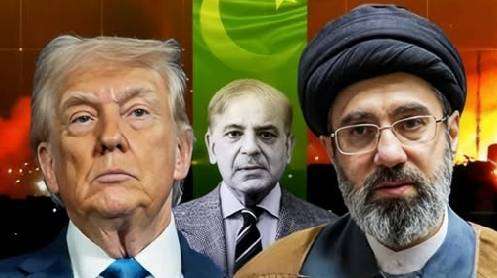
ISLAMABAD: In a significant diplomatic development, Pakistan has announced a two-week ceasefire agreement between the United States and Iran, following intensive backchannel engagements led by Prime Minister Shehbaz Sharif and Chief of Army Staff Asim Munir.
The truce, described as a critical step toward de-escalation in the Middle East, comes after direct communication with US President Donald Trump, who agreed to halt military strikes on Iran for a period of two weeks, contingent upon key conditions.
Ceasefire Announcement and Pakistan’s Role
Prime Minister Shehbaz Sharif, in an early morning statement, confirmed that both Iran and the United States—along with their respective allies—had agreed to an immediate ceasefire, including a pause in hostilities affecting Lebanon.
He praised the leadership on both sides for demonstrating “remarkable wisdom and understanding” and emphasized Pakistan’s role as a facilitator of peace. The prime minister also invited delegations from Tehran and Washington to Islamabad on April 10 for what he termed the “Islamabad Talks,” aimed at reaching a long-term settlement.
US Response and Conditional Agreement
Despite Pakistan’s announcement, the White House maintained a cautious stance. Press Secretary Karoline Leavitt noted that while discussions were ongoing, no formal agreement had been finalized at the highest level.
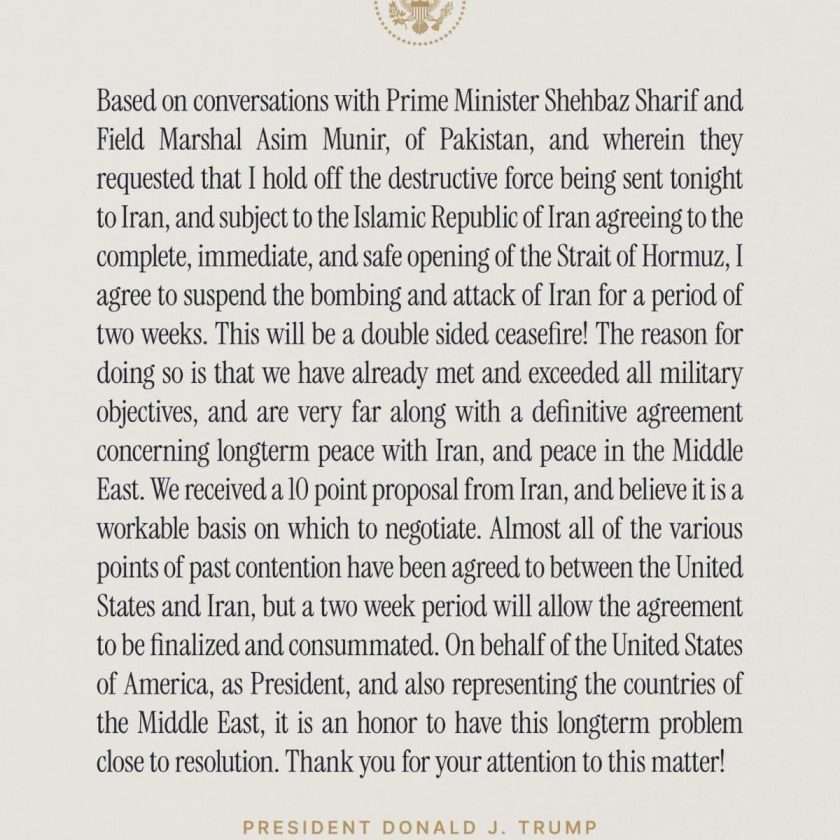
However, President Donald Trump confirmed that he had temporarily suspended planned military action after conversations with Prime Minister Shehbaz Sharif and Field Marshal Asim Munir.
Trump stated that the pause in hostilities was conditional upon Iran reopening the Strait of Hormuz, a critical global energy corridor, ensuring safe maritime passage for oil and gas shipments.
Iran’s Position and Strategic Concessions
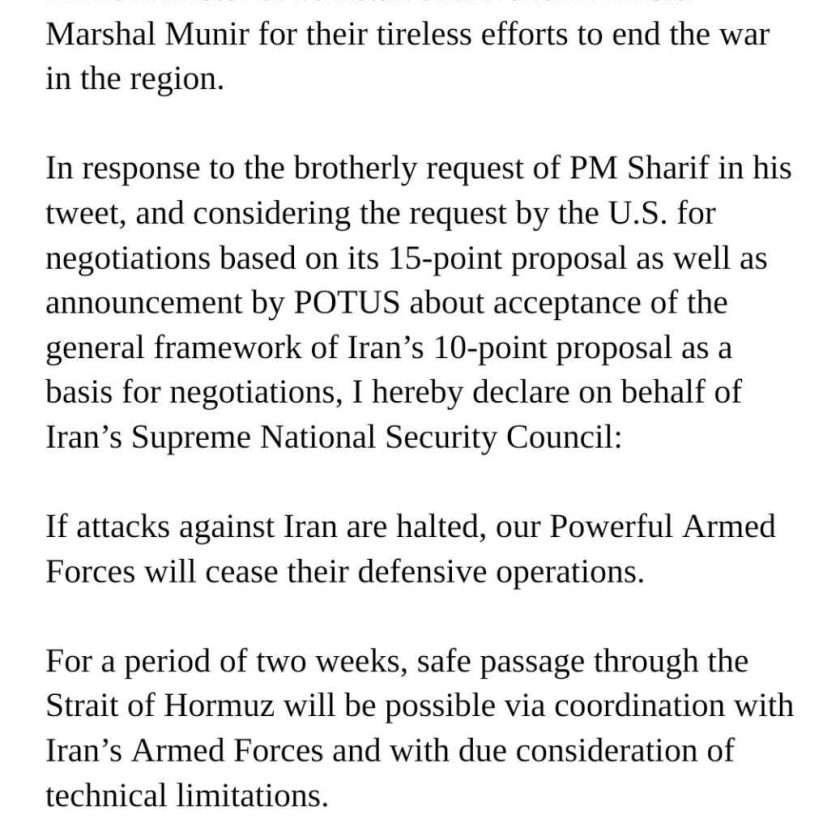
Iran responded positively to the diplomatic outreach. Foreign Minister Abbas Araghchi, speaking on behalf of Iran’s Supreme National Security Council, stated that Tehran would halt defensive operations if attacks ceased.
Iran also agreed to facilitate safe passage through the Strait of Hormuz for two weeks, aligning with Pakistan’s request as a goodwill gesture to enable diplomacy.
Tehran’s broader proposal reportedly includes key demands such as:
- Lifting of US sanctions
- Recognition of its nuclear rights
- Withdrawal of US forces from the region
- Compensation for war-related damages
Israel’s موقف and Regional Dynamics
Israeli Prime Minister Benjamin Netanyahu expressed support for Trump’s decision to pause strikes, though clarified that the ceasefire arrangement does not extend to Lebanon.
Israel reiterated its stance that any agreement must ensure Iran does not pose a nuclear or security threat to the region.
Strategic Importance of Strait of Hormuz
Central to the ceasefire agreement is the reopening of the Strait of Hormuz, through which nearly 20% of the world’s oil and LNG supplies pass. The waterway had faced disruptions amid escalating conflict, raising global energy security concerns.
President Trump stated that the United States would assist in managing maritime traffic in the region during the ceasefire period and hinted at potential economic opportunities arising from stability.
Diplomatic Momentum and Global Engagement
Pakistan’s diplomatic push extended beyond Washington and Tehran. Deputy Prime Minister and Foreign Minister Ishaq Dar engaged with counterparts from Saudi Arabia, Türkiye, Egypt, and Morocco to consolidate regional support for de-escalation.
These efforts build upon earlier multilateral engagements, including a quadrilateral meeting in Islamabad and subsequent consultations in Beijing, reflecting a coordinated international push for peace.
Path Toward Long-Term Peace
The two-week ceasefire is being viewed as a window of opportunity to finalize a broader agreement. President Trump indicated that both sides were already close to consensus on several contentious issues, with proposals exchanged forming the basis for a long-term deal.
Prime Minister Shehbaz Sharif expressed optimism that the upcoming Islamabad Talks would lead to a “conclusive agreement”, potentially ending months of escalating conflict in the region.
Conclusion
The ceasefire marks a rare moment of diplomatic convergence amid heightened tensions in the Middle East. While uncertainties remain—particularly regarding formal confirmations and implementation—the development underscores Pakistan’s emerging role as a key mediator in global geopolitics.
All eyes are now on Islamabad as it prepares to host crucial negotiations that could reshape the region’s security and energy landscape.