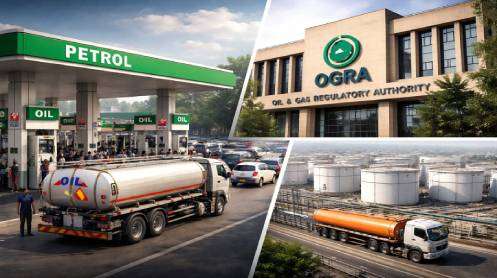
ISLAMABAD: Oil Marketing Companies (OMCs) are facing severe financial pressure as approximately Rs107 billion in Price Differential Claims (PDCs) remain unsettled, with industry sources pointing to continued delays by the Oil and Gas Regulatory Authority (OGRA) despite directives from the Ministry of Energy to expedite payments.
Sources said an initial claim of around Rs27 billion submitted in mid-March has only been partially cleared, while subsequent claims worth Rs70–80 billion are still pending, pushing total outstanding dues close to Rs107 billion.
At the heart of the issue is a lack of process consistency. OMCs report that OGRA has repeatedly revised documentation requirements, often changing formats within short timeframes. These include detailed invoice-level reconciliations and multiple certifications from CEOs, CFOs, and external auditors, complicating and delaying submissions.
Industry officials argue that the evolving requirements have turned a structured reimbursement mechanism into an uncertain and prolonged process. External auditors, typically responsible for system-level validation, are now being asked to verify transaction-level data—raising concerns about feasibility and compliance.
Adding to the pressure, OGRA is considering withholding 10% of admissible PDC payments until reconciliation with the Federal Board of Revenue (FBR), potentially locking up an additional Rs7.4 billion for up to two months.
PDCs arise when the government caps fuel prices below procurement costs, with the difference meant to be reimbursed to OMCs. Delays in these payments are forcing companies to rely on borrowing, increasing financial costs and squeezing already thin margins.
The impact is now spreading across the supply chain, with refineries and logistics providers tightening credit terms, while smaller OMCs face mounting working capital challenges. Industry sources warn that prolonged delays could eventually disrupt fuel supply, not due to operational constraints but financial stress.
OMCs have formally approached the Ministry of Energy, calling for immediate clearance of outstanding claims, a standardized documentation framework, and an end to frequent procedural changes. Until then, the disconnect between policy direction and regulatory execution continues to create uncertainty in the sector.