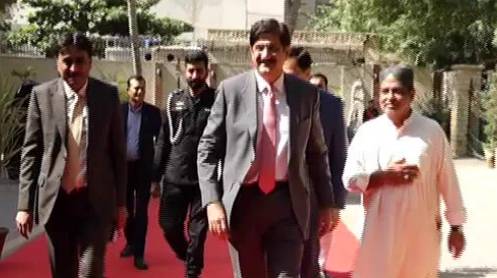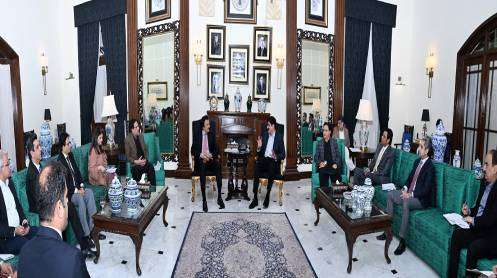
KARACHI (Jan 12): Sindh Chief Minister Syed Murad Ali Shah and the Prime Minister’s Special Assistant on Industry and Production, Haroon Akhtar, held a high-level meeting to forge a strategic partnership between the federal and provincial governments to foster Small and Medium Enterprise (SME) development in the province.
The meeting, held at CM House, was attended by Minister for Industries Jam Ikram Dharejo, Chief Secretary Asif Hyder Shah, Special Assistant to the CM for Investment Syed Qasim Naveed, and Secretary to CM Raheem Shaikh. The federal government delegation included Federal Secretary for Industries & Production Saif Anjum, Director General Fareedoon Akram, CEO SMEDA Nadia Jahangir and others.
The discussion centred on overcoming challenges such as limited access to finance and high production costs, while leveraging provincial initiatives to drive industrialisation.
A major highlight of the meeting was the joint commitment to revive the Red Chilli Processing (Dehydration) Unit in Kunri, Sindh. This project has received formal approval from both the SMEDA and Sindh Enterprise Development Fund (SEDF) Boards. The collaboration aims to modernise the chilli value chain, addressing a critical need in one of Sindh’s key agricultural clusters, the CM said.
Mr Shah said the Sindh Enterprise Development Fund (SEDF) was recognised as a cornerstone of the province’s economic strategy. He added that the lack of collateral, complex procedures, and the absence of dedicated SME banking networks hinder credit access. “Since June 2025, SBP has revoked its refinance schemes for SMEs that had subsidised credit facilities at 6 per cent,” he noted.
Murad Shah also said that varying definitions of SMEs across institutions create confusion and compliance burdens. The convoluted tax regime discourages formalisation and growth, especially for manufacturing units.
The chief minister said that rising energy tariffs, raw material prices, and logistics costs are squeezing profit margins. PM’s Special Assistant Haroon Akhtar also acknowledged that there was surplus electricity in the country, and that if a consensus is developed on reducing the tariff or offering special packages to SMEs, small industries would flourish and establish more and more units.
Many SMEs have had to scale down operations or lay off workers to stay afloat, the CM lamented. He added that many SMEs operate with obsolete machinery and lack access to modern production techniques, while workforce training in marketing, management, and international business practices is insufficient.
The meeting observed that multiple agencies with overlapping mandates lead to inefficiencies in SME facilitation. Coordination gaps between provincial and federal bodies slow down policy implementation.
Mr Shah said that SEDF has successfully mobilised private sector investments worth over Rs30.8 billion. These initiatives have resulted in the creation of more than 3,880 direct jobs. He added that the fund is recognised for supporting commercially viable projects with zero non-performing loans (NPLs).
To date, SEDF has supported 214 SMEs, including 25 women entrepreneurs, and subsidised 9,500 microloans for women in underserved areas. To address the lack of collateral and complex credit procedures, the Government of Sindh has introduced innovative financial solutions, the CM elaborated.
Through a partnership with HBL, SMEs can access loans of up to Rs10 million at a fixed markup rate of just 5 per cent, with SEDF covering the KIBOR-linked portion of the interest rate.
The establishment of the Sindh Business One Stop Shop (SBOSS) provides a single-window portal to simplify regulatory procedures and reduce bureaucratic delays, said Minister for Industries Jam Ikram Dharejo. He added that Sindh now hosts nine Special Economic Zones (SEZs) and 10 industrial estates, offering tax holidays and rebates to encourage formalisation.
Addressing the technology and skills gap is a top priority for the provincial government, the CM said. He added that the People’s Information Technology Programme (PITP) is providing free, industry-relevant IT training to over 48,000 youth. The Support for Start-ups, Incubators and Accelerators (SSI&A) initiative provides mentoring and grants to help new businesses scale, he said.
There was also a call for SMEDA to increase its project footprint in Sindh, as the province currently hosts only four out of 31 completed SMEDA projects.
The chief minister suggested reintroducing the State Bank of Pakistan (SBP) refinance schemes, which were revoked in June 2025, to restore subsidised credit at approximately 6 per cent. Haroon Akhtar said that he would take up the matter with the prime minister, who is keen to boost SMEs.
To combat rising energy tariffs, the meeting proposed offering tax and customs rebates (0% import duties) for SMEs adopting alternative or solar energy initiatives. It was agreed that the matter would be discussed with the prime minister for a final decision.