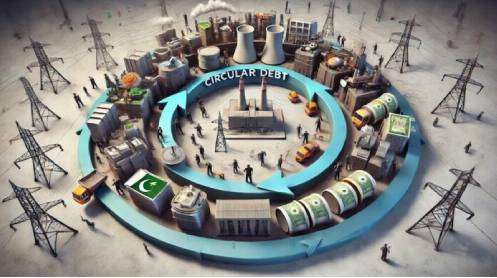
ISLAMABAD: Despite substantial capital injections and over Rs1.225 trillion in commercial borrowing during the last fiscal year, Pakistan’s power sector circular debt rose by Rs75 billion in the first half (July–December) of the current fiscal year, reaching Rs1.689 trillion — a 4.65 per cent increase in six months.
Thank you for reading this post, don't forget to subscribe!At the close of FY25 on June 30, 2025, circular debt stood at Rs1.614 trillion, having been reduced by Rs780 billion through government capital injections and about Rs1.225 trillion in commercial borrowing, largely aimed at replacing expensive Power Holding Private Limited (PHPL) debt with lower-cost financing. However, the debt stock rose by Rs79 billion in the first quarter (July–September) to Rs1.693 trillion.
Official data from the Power Division shows some improvement in the second quarter (October–December 2025), as circular debt marginally declined by Rs4 billion to Rs1.689 trillion, mainly due to stock payments amounting to Rs224 billion. This follows cumulative stock payments of Rs801 billion made during FY25.
Performance indicators, however, presented a mixed picture. System inefficiencies increased by Rs101 billion over six months, while non-payments from K-Electric surged to Rs115 billion. As a result, the circular debt stock stood at Rs1.689 trillion by December 31, 2025, compared to Rs2.384 trillion in the same period last year after accounting for a Rs780 billion capital injection. The decline was partly offset, with nearly Rs85 billion added back to the reduced stock of Rs695 billion.
Payables to power producers, which were Rs861 billion at the end of FY25, rose to Rs903 billion in the first half of the current fiscal year. Circular debt financing during this period amounted to Rs694 billion.
Containment efforts were supported by a Rs42 billion reduction in budgeted but unreleased subsidies and a sharp fall in interest charges to Rs10 billion, compared to Rs56 billion in the same period last year, mainly due to reduced PHPL debt servicing and settlements with independent power producers (IPPs).
Prior-year adjustments from consumers, which had declined by Rs140 billion in the first half of FY24, increased by Rs95 billion in the first half of FY25. Meanwhile, non-payments from K-Electric escalated sharply — from Rs12 billion in the first half of FY24 to Rs115 billion this year. Total receivables from the Karachi-based utility reached Rs329 billion by December 31, 2025, including Rs136 billion in principal and Rs193 billion in markup.
The Power Division noted that FY26 began with circular debt of Rs1.614 trillion, compared to Rs2.467 trillion a year earlier. Payables to power producers peaked at Rs944 billion by the end of September but were reduced to Rs903 billion in the following quarter. Although circular debt increased by Rs224 billion during July–November 2025, it was offset by an equivalent stock payment in December.
A Power Division spokesperson cautioned against comparing debt levels at the end of June with those at the end of November, explaining that seasonal factors significantly affect monthly circular debt flows. He said the Rs1.225 trillion commercial borrowing was intended to refinance PHPL’s costly debt with cheaper loans under a five- to six-year repayment plan through a debt servicing surcharge.
According to the spokesperson, seasonal increases during July–November are typically reversed by half-yearly payments, as seen in December 2025, resulting in a net circular debt flow of less than Rs80 billion for July–December. He added that circular debt had declined substantially in FY25 due to improved distribution companies’ efficiencies, better macroeconomic conditions, and the waiver of late payment surcharges after negotiations with IPPs.
The Power Division expressed confidence that by the end of the current fiscal year, circular debt would be fully contained with no net addition to the overall stock, consistent with historical trends where seasonal fluctuations normalise in the latter half of the year. It also reiterated that seasonal variations do not impact consumer-end electricity tariffs and claimed that Disco inefficiencies in FY25 were reduced by Rs193 billion compared to FY24.
The government’s Rs1.225 trillion circular debt settlement plan is to be implemented over six years, refinancing existing debt on favourable terms. The first tranche under this plan has already been received.
Story by Khaleeq Kiani