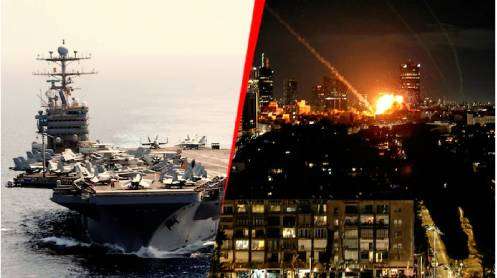
JERUSALEM: The conflict between Iran and the US-Israel alliance escalated dramatically on Sunday after Iran confirmed the assassination of Supreme Leader Ali Khamenei in a joint US-Israeli airstrike — a development that has plunged the region into one of its most dangerous crises in decades.
Iran declared 40 days of national mourning and announced seven public holidays following the death of the leader who had held ultimate authority since 1989. Iranian state media reported that Khamenei was killed while working in his office during Saturday’s coordinated strikes.
In retaliation, Iranian missile barrages struck central Israel, killing at least nine people in the city of Beit Shemesh and injuring dozens more, according to Israeli emergency services. Several people remain missing.
Senior Iranian Leadership Targeted
The Israeli military said approximately 40 senior Iranian officials were killed in the coordinated assault, including six confirmed by Iranian state media. Among them were:
- Gen. Mohammad Pakpour, Revolutionary Guards commander
- Abdolrahim Mousavi, armed forces chief of staff
- Aziz Nasirzadeh, defence minister
- Mohammad Shirazi, head of the Supreme Leader’s military office
- Gholamreza Rezaian, police intelligence chief
- Ali Shamkhani, senior security adviser
Iranian reports also stated that members of Khamenei’s family were killed in the strike.
Trump Signals Extended Campaign
US President Donald Trump claimed the operation had been meticulously monitored, stating that intelligence tracked Khamenei’s movements and that Iranian leaders “could do nothing” to prevent the attack.
Trump suggested the military campaign could last around four weeks.
“It’s always been a four-week process,” he told media outlets, adding that while casualties were expected, the outcome would be “a great deal for the world.”
The Pentagon confirmed that three US service members had been killed during operations.
US Central Command reported striking an Iranian Jamaran-class naval corvette in the Gulf of Oman, claiming it was sinking. It also stated that B-2 stealth bombers targeted hardened ballistic missile facilities using 2,000-pound munitions.
Expanding Regional Fallout
Iran’s Revolutionary Guards claimed to have targeted US bases across the region and alleged that three US and British oil tankers were struck in the Gulf and the Strait of Hormuz, though independent confirmation was lacking. The Pentagon denied Iranian claims that the US aircraft carrier USS Abraham Lincoln had been hit.
Shipping data indicated immediate disruption across the Gulf. At least 150 oil and LNG tankers reportedly anchored in open waters to avoid the Strait of Hormuz, a chokepoint for more than 20 percent of global oil trade. Major shipping companies MSC and Maersk suspended navigation in the area.
Iranian authorities declared the Strait closed and warned vessels against passage, intensifying concerns over global energy markets.
Diplomatic Channels Still Open
Despite the escalation, diplomatic efforts continued. Oman’s foreign ministry said Iranian Foreign Minister Abbas Araghchi informed Omani officials that Tehran remained open to “serious efforts at de-escalation.”
Oman’s Foreign Minister, Badr Albusaidi, who has previously mediated US-Iran talks, stressed that “the door to diplomacy remains open,” adding that earlier negotiations in Geneva had made genuine progress before the outbreak of war.
Meanwhile, the United Nations nuclear watchdog announced an emergency meeting on Iran at Russia’s request.
European Union foreign policy chief Kaja Kallas described Khamenei’s death as “a defining moment in Iran’s history,” noting uncertainty over what political direction Iran may now take.
Mounting Casualties and Military Mobilisation
In western Iran, more than 40 security personnel were reportedly killed in a strike on a border regiment headquarters in Mehran near Iraq. Iranian agencies also accused US-Israeli forces of striking Tehran’s Gandhi Hospital, releasing footage of debris inside the facility.
Israel announced plans to mobilise nearly 100,000 reservists as part of its campaign — dubbed Operation “Roaring Lion” — signalling preparation for a prolonged conflict.
As tit-for-tat strikes intensify across land, sea and air, analysts warn that the assassination of Iran’s supreme leader marks a historic turning point — one that risks drawing regional and global powers into a broader and potentially uncontrollable war.
By Agencies | Monitoring Desk