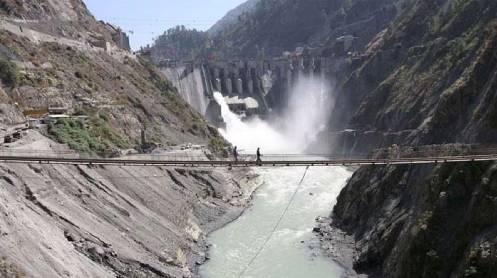
ISLAMABAD: A reported $60 billion investment by India in water storage infrastructure along the western rivers — the Jhelum River and the Chenab River — has sparked serious concerns in Pakistan over potential water security risks, including the possibility of engineered floods and droughts.
At a recent federal-provincial dialogue on water storage projects, Chairman of the Water and Power Development Authority (Wapda), retired Lt Gen Muhammad Saeed, reportedly informed participants that India’s planned investments could expand its storage capacity on the two rivers from roughly 15 days at present to between 55 and 60 days.
Participants at the meeting warned that such enhanced capacity would allow India to regulate flows over nearly two months — a timeframe that could critically affect Pakistan’s agriculture sector, particularly during peak irrigation demand.
“India could potentially restrict flows during crucial cropping periods, causing drought conditions downstream,” one official briefed at the meeting said. “Conversely, during the monsoon, stored water could be released suddenly, intensifying flood risks.”
Call for Urgent Storage Development
Officials stressed that Pakistan must urgently develop large-scale reservoirs to capture excess floodwater for use during potential disruptions, and to cushion against sudden releases that could devastate downstream communities.
The Wapda chairman underscored the need for new flood storage reservoirs to conserve surplus flows and mitigate future shocks. Another official warned that the “weaponisation” of river flows through upstream storage could pose existential challenges if not countered through proactive infrastructure development.
The session, held on February 17, was chaired by Federal Minister for Water Resources Mian Moeen Wattoo and attended by the Prime Minister of Azad Jammu and Kashmir (AJK) and the Chief Minister of Gilgit-Baltistan (GB). However, provincial chief ministers did not attend, though chief secretaries and irrigation secretaries were directed to participate.
Divergent Provincial Views
Sindh’s irrigation leadership expressed reservations, noting that Pakistan already faces water scarcity and arguing that current river flows may not justify construction of another large dam.
Officials from Sindh warned that lower riparian regions are struggling to secure adequate drinking water under existing conditions and cautioned that additional upstream storage could exacerbate shortages. They called for detailed feasibility and economic assessments before any final decision.
There were also concerns about rushed infrastructure projects undertaken in response to geopolitical pressures. Some officials indirectly referenced the Rs500 billion Neelum-Jhelum Hydropower Project, which has faced operational challenges, as an example of the risks associated with hurried development.
Regional Stakeholders Seek Greater Role
The leadership of Gilgit-Baltistan proposed that the region be granted membership — or at least observer status — in the Indus River System Authority (Irsa) to ensure broader national representation in water governance decisions.
The AJK Prime Minister supported the development of additional dams and hydropower projects, citing Kashmir’s role as the source of major river flows. However, he emphasized that local communities should receive financial incentives and economic benefits in return for hosting such infrastructure.
Punjab expressed full support for new flood storage projects and offered institutional guarantees to address Sindh’s concerns. Meanwhile, Khyber Pakhtunkhwa urged expedited development of the Chashma Right Bank Canal lift-cum-gravity project, arguing that without it, the province cannot effectively utilize its allocated water share. Wapda assured that tenders for the project had already been issued and that it would be prioritized.
Medium-Sized Storage Projects Underway
Separately, Wapda is understood to have finalized plans for four medium-sized storage facilities on the Chenab near Jhang, Chiniot, Sargodha and Wazirabad. Estimated to cost around Rs300 billion, these projects would collectively provide storage capacity of approximately 4.5 million acre-feet.
As regional water dynamics grow increasingly complex, policymakers warn that strengthening Pakistan’s storage capacity is no longer just a development priority — but a strategic necessity.
Story by Khaleeq Kiani