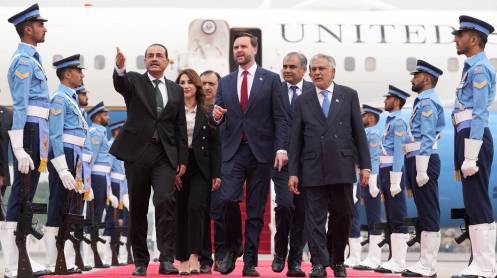
ISLAMABAD: JD Vance arrived in Islamabad on Saturday morning, leading a high-level United States delegation for what are being described as “make-or-break” talks with Iranian leadership — a rare diplomatic engagement amid ongoing regional tensions.
The negotiations come during a fragile two-week ceasefire in the conflict involving Iran and United States, following hostilities that erupted after the US-Israel attacks on Iran Feb 2026. The truce, brokered with facilitation from Pakistan, temporarily halted widespread violence across the Middle East.
Upon arrival at Nur Khan Air Base, Vance was received by Deputy Prime Minister Ishaq Dar, Chief of Army Staff Asim Munir, and Interior Minister Mohsin Naqvi. Pakistan’s Foreign Office welcomed the US delegation and reiterated its commitment to facilitating a peaceful and lasting resolution.
The US delegation includes senior officials such as Jared Kushner and Middle East envoy Steve Witkoff, along with representatives from the National Security Council, State Department, and Department of Defense.
On the Iranian side, the delegation is led by Parliament Speaker Mohammad Bagher Ghalibaf, accompanied by Foreign Minister Abbas Araghchi and other senior officials.
These talks mark the first direct high-level engagement between Washington and Tehran since 1979. However, the path to dialogue has been fraught with challenges. Iran had initially conditioned its participation on a ceasefire in Lebanon and the release of approximately $7 billion in frozen assets — demands that were partially addressed to enable the meeting.
Ahead of the talks, Donald Trump signaled a firm stance, warning that military action could resume if negotiations fail, while also criticizing Iran’s continued restrictions on shipping through the strategically critical Strait of Hormuz.
Prime Minister Shehbaz Sharif emphasized Pakistan’s role as a facilitator, expressing hope that dialogue would lead to a peaceful resolution of longstanding disputes.
The agenda remains complex, covering Iran’s nuclear programme, sanctions relief, regional proxy dynamics, missile capabilities, and maritime security. While expectations for immediate breakthroughs remain low, analysts suggest the talks could pave the way for continued engagement and potential de-escalation.
Despite cautious optimism, the negotiations are unfolding under intense pressure, with ongoing tensions in Lebanon, disruptions in Gulf shipping routes, and deep-rooted mistrust between the two sides continuing to cast a shadow over the process.