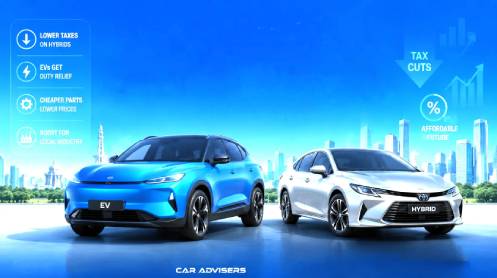
ISLAMABAD: The government is considering imposing up to 25 percent sales tax on imported electric vehicles (EVs) in the upcoming federal budget, while existing concessional tax rates for hybrid vehicles are expected to remain unchanged for the next fiscal year, sources told Business Recorder.
Several sales tax exemptions currently available to the EV sector are scheduled to expire on June 30, 2026. Among them is the exemption on the import of completely knocked down (CKD) kits for electric vehicles by local manufacturers.
The exemption presently covers small electric cars and SUVs with battery capacities of up to 50 kWh, as well as light commercial vehicles (LCVs) equipped with batteries of up to 150 kWh.
At present, locally manufactured or assembled four-wheel electric vehicles benefit from a reduced sales tax rate of one percent until June 30, 2026. This concession applies to small cars, SUVs, and LCVs falling within the prescribed battery capacity limits.
Similarly, locally manufactured hybrid electric vehicles currently enjoy reduced sales tax rates ranging from 8.5 percent to 12.75 percent, a facility that is also set to expire at the end of June 2026. Sources indicate that these concessional rates are likely to remain intact in the upcoming budget.
Meanwhile, the Senate Standing Committee on Finance has approved the Customs (Amendment) Bill, 2026, aimed at implementing the financial provisions of the Automotive Industry Development and Export Policy (AIDEP) 2021-26.
The proposed amendments seek to align customs duty concessions with the objectives of AIDEP, which focuses on promoting local manufacturing, exports, and the adoption of environmentally friendly transportation technologies.
To support the transition toward cleaner mobility, the government has proposed extending customs duty concessions on the import of EV parts and components until June 30, 2026. The move is intended to encourage domestic EV production and facilitate investment in Pakistan’s emerging electric vehicle industry.
The federal cabinet originally approved the EV Policy 2020 on June 16, 2020, introducing concessional customs duties for a five-year period beginning July 1, 2020. The incentives covered imports of EV-specific parts for electric two- and three-wheelers, selected completely built-up (CBU) electric vehicles, and components for electric heavy commercial vehicles, including buses, trucks, and prime movers.
These concessions were incorporated into Part V(A) of the Fifth Schedule to the Customs Act, 1969, through the Finance Act, 2020.
Subsequently, under AIDEP 2021-26, approved by the federal cabinet on December 21, 2021, the government extended these incentives until June 30, 2026. The policy also expanded concessions to include EV-specific parts and components for light commercial vehicles and vans on terms similar to those available for other four-wheeler EVs.
The Customs (Amendment) Bill, 2026, further proposes extending customs duty concessions on the import of completely built electric vehicles until June 30, 2026. Under the scheme, manufacturers will be allowed to import up to 10 units of a particular EV variant intended for local assembly or production, while a maximum limit of 200 units will apply to the two- and three-wheeler segments.
The concession will remain available only for vehicles approved and certified by the relevant authorities under the EV Policy 2020 and the Engineering Development Board’s regulatory framework.
Industry stakeholders are closely watching the upcoming budget announcements, as changes in the taxation regime could significantly influence EV adoption, local manufacturing investment, and Pakistan’s broader transition toward sustainable transportation.
Story by Sohail Sarfraz