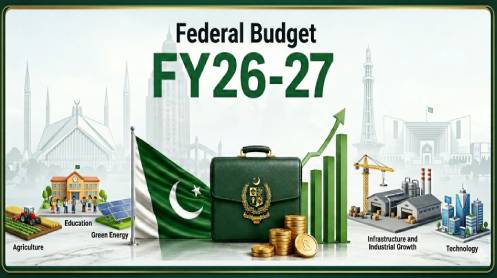
ISLAMABAD: Adhering to key conditions set by the International Monetary Fund (IMF) while attempting to stimulate economic activity, Finance Minister Muhammad Aurangzeb on Friday unveiled the federal budget for FY2026-27, featuring tax relief for salaried individuals, businesses, exporters, and the real estate sector alongside enhanced allocations for defence and social protection.
Presenting his third federal budget, the finance minister outlined a strategy focused on boosting productivity, exports, agricultural output, and the information technology sector while maintaining fiscal discipline under the IMF programme.
A major feature of the budget is a three-year arrangement with provinces under a framework of “cooperative federalism,” under which provincial transfers from the federal divisible pool will effectively remain frozen until FY2028-29. The move is aimed at creating additional fiscal space to meet strategic national priorities, including defence and emergency requirements.
Tax Relief and Salary Increase
The government announced a 7% increase in salaries and pensions for federal employees and pensioners, while the minimum wage has been raised by 10% to Rs40,700 per month.
Income tax relief has also been provided to salaried individuals. Tax rates have been reduced by:
- 3 percentage points for annual incomes between Rs2.2 million and Rs3.2 million.
- 5 percentage points for incomes between Rs3.2 million and Rs4.1 million.
- 6 percentage points, lowering the rate to 29%, for incomes between Rs4.1 million and Rs5.6 million.
For businesses, the government has abolished the super tax on incomes ranging from Rs150 million to Rs500 million and reduced the rate by 2 percentage points to 8% for incomes exceeding Rs500 million. However, banks, oil and gas exploration companies, and fertiliser manufacturers will continue to pay the existing rates.
The budget also includes tax concessions for the real estate and construction sectors, aimed at reviving investment and supporting allied industries such as cement, steel, glass, paint, and ceramics.
New Tax Measures
The government proposed several new revenue measures, including:
- Taxation of earnings generated through social media platforms.
- A fixed tax regime for small traders and shopkeepers.
- Higher minimum tax rates for wholesalers and retailers.
- Incentives for small electric vehicles and electric motorcycles.
- Regulatory barriers on luxury electric vehicle imports.
Ambitious Revenue Target
Despite a record Rs1.15 trillion tax shortfall during the outgoing fiscal year, the government has set an ambitious Federal Board of Revenue (FBR) target of Rs15.264 trillion for FY2026-27, representing an increase of Rs2.28 trillion or 17.6% over the revised collection estimate of Rs12.983 trillion.
The government expects approximately Rs650-700 billion to come from new tax measures and improved enforcement, while the remainder is projected to result from economic growth and inflation.
Provincial Transfers Frozen
Although total FBR collections are projected at Rs15.264 trillion, the divisible pool for federal-provincial distribution has been capped at Rs13.35 trillion. The remaining Rs1.9 trillion will remain available to the federal government through grants under Article 164 of the Constitution.
According to the finance minister, this arrangement was agreed upon by both federal and provincial governments and will support strategic national priorities without affecting the constitutional rights of provinces.
Higher Defence and Emergency Spending
Defence expenditure has been increased by 17.7% to Rs3 trillion, reflecting heightened security concerns and regional uncertainties.
In addition:
- Other grants have been increased by 39% to Rs2.53 trillion.
- Emergency allocations have been raised to Rs430 billion, including Rs20 billion earmarked for natural disasters.
Aurangzeb stated that the enhanced defence allocation was necessary to strengthen the country’s security and preparedness amid evolving regional challenges.
IMF Targets Maintained
Despite introducing relief measures, the government has retained key IMF-agreed fiscal targets:
- FBR revenue: Rs15.264 trillion
- Primary surplus: Rs2.83 trillion (2% of GDP)
- Fiscal deficit: Rs5.23 trillion (3.6% of GDP)
The budget also assumes a provincial cash surplus of Rs1.8 trillion under the IMF-backed National Fiscal Pact.
Petroleum Sector Emerges as Key Revenue Source
With profits from the State Bank of Pakistan expected to decline significantly due to lower interest rates, the petroleum sector is set to become the largest contributor to non-tax revenue.
Total non-tax revenue is projected at Rs5.34 trillion, with the petroleum sector expected to contribute Rs2.03 trillion, including approximately Rs1.68 trillion from petroleum-related levies and charges.
Rising Debt Servicing and Pension Costs
Total federal expenditure has been estimated at Rs18.77 trillion, while debt servicing remains the largest expenditure item.
The government has allocated:
- Rs8 trillion for interest payments.
- Rs1.17 trillion for pensions, including Rs822 billion for military pensions and Rs272 billion for civilian pensioners.
The 7% pension increase is expected to add an additional Rs64.5 billion to expenditure.
Reduced Subsidies, Focus on Power Sector
Overall subsidies have been reduced to Rs1.09 trillion from Rs1.16 trillion in the outgoing fiscal year.
Power sector subsidies have been trimmed to Rs830 billion, although support for K-Electric has been increased by 30% to Rs163 billion, while subsidies for Azad Jammu and Kashmir have also been enhanced.
A separate allocation of Rs252 billion has been reserved for tackling the power sector’s circular debt challenge.
The FY2026-27 budget reflects the government’s attempt to strike a delicate balance between meeting IMF-mandated fiscal targets, supporting economic recovery, strengthening national security, and providing targeted relief to taxpayers and businesses.
Story by Khaleeq Kiani