KARACHI: The federal budget for FY2026-27 introduced limited changes for Pakistan’s auto sector, with policymakers opting to defer major reforms until the announcement of the forthcoming Auto Policy 2026-31, expected to take effect from July 1 following approval by the prime minister and federal cabinet.
Presenting the budget, Finance Minister Muhammad Aurangzeb stated that the new auto policy is currently under review by the Prime Minister’s Committee and will be presented before Parliament once finalized.
EV Incentives Extended
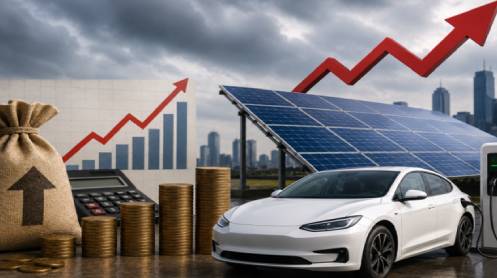
As part of the government’s push toward cleaner transportation, incentives on the import of Completely Knocked Down (CKD) kits for electric vehicles—including electric bikes, three-wheelers, cars, buses, and trucks—have been extended until June 30, 2027.
At present, import duties on EV CKD kits stand at:
- 1% on specified components,
- 10% on non-localized parts, and
- 25% on localized parts.
Meanwhile, imported Completely Built-Up (CBU) electric vehicles continue to attract a 25% import duty.
Industry stakeholders noted that greater clarity on taxation and incentives is expected once the Finance Bill FY2026-27 and the new auto policy are formally released.
Higher Duties on Luxury Vehicles and Premium EVs
The government has proposed an increase in Federal Excise Duty (FED) on imported vehicles with engine capacities ranging from 2,000cc to 3,000cc. The enhanced duty will also apply to imported electric vehicles valued above Rs20 million.
In addition, duties on imported vehicles with engine capacities exceeding 3,000cc have also been increased.
Industry analysts believe the measure targets the luxury vehicle segment, where sales volumes remain relatively small but demand continues among high-income consumers. Local assemblers involved in importing premium vehicles may also be affected by the revised taxation structure.
Incentives for Electric Trucks
To encourage infrastructure and development projects, imported electric trucks will be subject to a concessional sales tax rate of just 1%.
Market experts view this as a positive step aimed at supporting transportation needs linked to major infrastructure initiatives, including projects under the China-Pakistan Economic Corridor (CPEC) and private-sector development programmes.
Auto Sector Maintains Growth Momentum
Pakistan’s automobile sector has continued to recover strongly, supported by lower interest rates and improving consumer confidence.
According to available data:
- Imports of new and used vehicles increased by 24% to $282 million during July-April FY2025-26.
- Imports of semi-knocked-down (SKD) and CKD kits by local assemblers surged by 107% year-on-year to $1.7 billion during the same period.
The strong growth in kit imports suggests robust vehicle production and sales activity in the coming months.
The finance minister also highlighted the expansion of Pakistan’s automotive manufacturing base, noting that the country now hosts 118 assemblers across the two-, three-, and four-wheeler segments.
Revenue Measures Amid IMF Commitments
Industry observers noted that while Pakistan is committed to gradually reducing customs and regulatory duties under its IMF-backed reform programme, the increase in FED on luxury vehicles appears designed to compensate for potential revenue losses resulting from tariff reductions.
Used vehicle importers argued that the revised duty structure reflects the government’s effort to balance revenue generation with broader trade liberalization commitments.
NEV Policy Targets 30% Market Share by 2030
According to the Economic Survey FY2025-26, the government’s New Energy Vehicle (NEV) Policy 2025-2030 aims to transform Pakistan’s transport sector through the widespread adoption of electric and alternative energy vehicles.
The policy targets 30% of all new vehicle sales by 2030—equivalent to approximately 2.2 million vehicles—to consist of electric and other new energy vehicles, including e-bikes, scooters, rickshaws, passenger cars, light commercial vehicles, buses, and trucks.
To accelerate adoption, the government plans to support consumers and manufacturers through the Pakistan Accelerated Vehicle Electrification programme, viability gap funding, and investments in charging and supporting infrastructure.
While the FY2026-27 budget offers continued support for electric mobility, industry stakeholders are now looking toward the upcoming Auto Policy 2026-31 for a clearer roadmap on localization, investment incentives, taxation, and the long-term development of Pakistan’s automotive sector.
Story by Aamir Shafaat Khan