ISLAMABAD: South Korea’s state-owned Korea South-East Power Company (KOEN) has called on the Government of Pakistan to remove regulatory bottlenecks delaying nearly $1 billion in planned hydropower investments, warning that pending tariff approvals and uncertainty surrounding the country’s future power generation roadmap are putting two major renewable energy projects at risk.
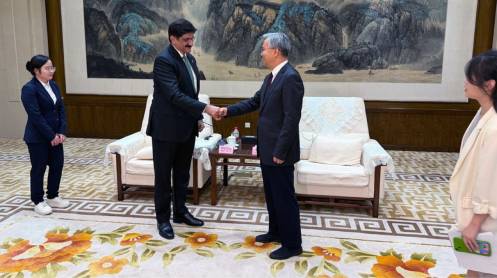
The concerns were raised during a meeting between Federal Minister for Commerce Jam Kamal Khan and a high-level KOEN delegation led by Chief Executive Officer Kim Min Young. The delegation also included Deputy CEO Jang Sungkyu, Chief Operating Officer Javid Rashid Chaudhary, Director Finance Asim Javed, and General Manager Project Development Shahid Javid.
During the meeting, KOEN’s Director Finance, Asim Javed, presented a comprehensive overview of the company’s investments in Pakistan, highlighting the progress of its hydropower portfolio, financing arrangements, regulatory approvals obtained, and the support required from relevant government institutions.
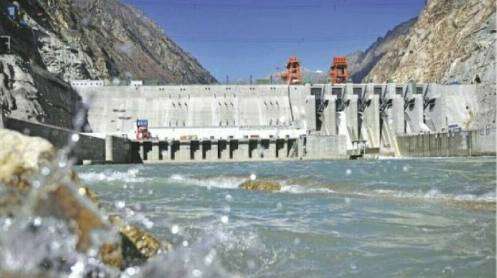
KOEN informed the minister that it has been investing in Pakistan’s energy sector since 2011. The company successfully commissioned the 102 MW Gulpur Hydropower Project in March 2020 and subsequently launched two major hydropower projects in Swat under the Power Generation Policy 2015: the 229 MW Asrit Kedam Hydropower Project and the 238 MW Kalam Asrit Hydropower Project.
According to the delegation, key project milestones have already been achieved, including feasibility studies, environmental approvals, land acquisition processes, IRSA clearances, and grid interconnection studies. KOEN also revealed that it has secured approximately $1 billion in debt and equity financing for the projects while investing around $25 million in development studies and preparatory work.
However, the company expressed concern over the delay in tariff determination, the uncertain status of the projects in the draft Indicative Generation Capacity Expansion Plan (IGCEP) 2025–2035, and the lack of clarity regarding their future implementation. KOEN emphasized that timely government decisions are essential to maintain investor confidence and prevent further project delays.
The delegation noted that both projects would significantly enhance Pakistan’s clean energy capacity while generating employment opportunities, supporting local development, and stimulating economic growth in the Swat region. KOEN reaffirmed its long-term commitment to Pakistan and expressed its willingness to align its investment plans with the country’s evolving energy needs.
Welcoming KOEN’s continued interest, Commerce Minister Jam Kamal Khan appreciated the company’s confidence in Pakistan’s long-term investment potential and reaffirmed the government’s commitment to attracting foreign investment in renewable energy and sustainable infrastructure.
“Pakistan values its economic partnership with the Republic of Korea and welcomes investment in renewable energy, technology, logistics, and other priority sectors,” the minister said.
He stressed that creating a stable, transparent, and investor-friendly business environment is essential for attracting long-term international investment, adding that effective coordination among government institutions would be critical in strengthening investor confidence.
Jam Kamal assured the delegation that the relevant federal ministries, departments, and regulatory authorities would be engaged to facilitate coordinated consideration of KOEN’s concerns.
While acknowledging that Pakistan is currently reassessing its power generation requirements due to existing surplus capacity, the minister noted that significant future opportunities are expected to emerge through the expansion of green energy, industrial development, data centres, and other high-growth sectors.
He reaffirmed that the Ministry of Commerce would continue supporting constructive engagement between KOEN and relevant stakeholders to help advance the company’s investment plans in Pakistan’s renewable energy sector.