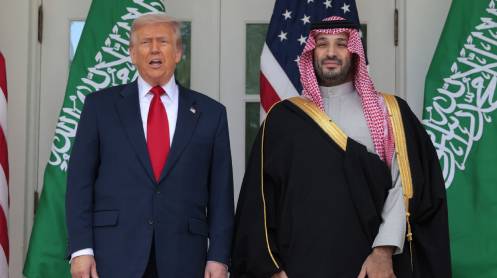
WASHINGTON: The United States and Saudi Arabia have signed a landmark civil nuclear cooperation agreement that will allow the Kingdom to develop nuclear power plants using American technology, marking a significant milestone in bilateral strategic relations while reigniting debate over nuclear proliferation in the Middle East.
Thank you for reading this post, don't forget to subscribe!The agreement, announced by the US Department of Energy on Wednesday, enables Saudi Arabia to build civilian nuclear reactors with US technology and grants the Kingdom the right to enrich uranium and reprocess nuclear waste—activities that can also provide pathways for developing nuclear weapons if diverted from peaceful purposes.
The pact, formally known as a 123 Agreement, was signed by US Energy Secretary Chris Wright and Saudi Energy Minister Prince Abdulaziz bin Salman, alongside a bilateral safeguards agreement.
Negotiations on a civil nuclear partnership have continued through both President Donald Trump’s first administration and the subsequent administration of President Joe Biden. However, previous efforts failed to reach completion due to concerns raised by non-proliferation advocates over the potential security implications.
Unlike proposals advanced during the Biden administration, the newly signed agreement does not require Saudi Arabia to adopt the Additional Protocol of the International Atomic Energy Agency (IAEA), which permits more extensive and unannounced inspections of nuclear facilities.
The agreement also differs from the UAE’s 2009 civil nuclear deal with Washington, under which Abu Dhabi voluntarily agreed not to enrich uranium or reprocess spent nuclear fuel.
According to the US Energy Department, the agreement complies with the non-proliferation requirements of the US Atomic Energy Act and includes safeguards designed to ensure the peaceful use of nuclear technology. US officials have argued that partnering with Saudi Arabia will help maintain high international nuclear safety standards, noting that Riyadh has previously indicated it could seek similar cooperation from China or Russia if a US agreement was not reached.
The agreement will now be submitted to the US Congress for review. Under US law, it will take effect unless lawmakers pass a resolution of disapproval within 90 legislative session days. Any attempt to block the agreement would require sufficient congressional support to overcome a potential presidential veto.
The long-term agreement, expected to span approximately 30 years, is estimated to be worth tens of billions of dollars and is expected to benefit Westinghouse Electric Company, which manufactures the AP1000 nuclear reactor technology and is jointly owned by Canada’s Cameco and Brookfield Asset Management.
Industry sources said the project will begin with a feasibility study to assess the deployment of US nuclear technology in Saudi Arabia. Given the lengthy planning, licensing and construction timelines associated with nuclear power projects, commercial operations are expected to take several years.
The agreement has drawn mixed reactions in Washington. Arms control experts and several Democratic lawmakers warned that allowing Saudi Arabia to enrich uranium could increase nuclear proliferation risks and potentially trigger a regional arms race.
Kelsey Davenport, Director for Non-Proliferation Policy at the Arms Control Association, urged Congress to reject or amend the agreement, arguing that it could further weaken efforts to prevent the spread of nuclear weapons in the Middle East.
Saudi Crown Prince Mohammed bin Salman has repeatedly stated that the Kingdom seeks nuclear technology for peaceful purposes but has also said Saudi Arabia would pursue nuclear weapons if Iran were to develop one. Those remarks have continued to fuel concerns among non-proliferation experts amid ongoing regional tensions.
While critics argue the agreement could undermine regional security, supporters, including Republican Senator Jim Risch, maintain that the partnership will strengthen US-Saudi strategic cooperation and advance both countries’ long-term energy and economic interests.
By Reuters