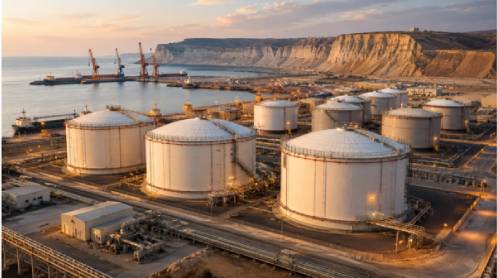
ISLAMABAD: The government has launched work on an ambitious plan to establish an integrated oil city at Hub, Balochistan, featuring an offshore Single Point Mooring (SPM) facility, dedicated crude oil and petroleum product pipelines, and large-scale bonded storage infrastructure.
The proposed project is aimed at transforming Hub into a major petroleum logistics and trading hub while providing Pakistan with additional capacity to handle large crude oil and petroleum product vessels and reducing pressure on existing port infrastructure at Karachi and Port Qasim.
According to official sources, consultancy firm Technique has been engaged to conduct a basic feasibility study of the proposed oil city. The study will assess the technical and commercial viability of the project and recommend whether the required infrastructure should proceed to the development stage.
The study is expected to be completed within two months, following which the government will decide on the next phase.
The proposed oil city would be developed on government land at Hub that was previously allocated to PARCO for a coastal refinery. The government now plans to utilise the strategically located land for a broader petroleum infrastructure project encompassing import handling, storage, pipeline connectivity and petroleum product distribution.
During a recent visit to Karachi, the Petroleum and Natural Resources Minister was briefed by PARCO management on the proposal. The company presented its concept paper, following which the minister directed PARCO to undertake the basic feasibility study and further develop the project.
Offshore SPM to handle large vessels
Under the proposed concept, an offshore Single Point Mooring facility would be established in deep water, enabling large crude oil tankers and petroleum product vessels to discharge cargo without entering shallow-water port facilities.
The SPM would be connected to the mainland through two dedicated pipelines. One would transport imported crude oil towards KPT’s Keamari facilities, while the second would carry finished petroleum products towards Port Qasim, with connectivity to the existing White Oil Pipeline (WOP) network.
The infrastructure could significantly improve Pakistan’s flexibility in handling large vessels and strengthen the country’s petroleum import and distribution network.
Bonded storage to support petroleum trade
The proposed oil city is also being linked with the government’s renewed customs-bonded storage policy, under which petroleum companies and international traders would be able to store imported products in bonded facilities without immediately paying applicable duties and taxes, subject to the relevant regulatory framework.
Official sources said bonded storage facilities are planned for Hub, while Gulf-based companies have shown strong interest in developing petroleum storage facilities at strategic locations, including Port Qasim, Keamari, Gwadar and Hub.
The government has also proposed bonded petroleum product storage facilities at Kot Addu, Machike and Faisalabad, potentially creating a wider coastal and inland petroleum storage network.
Pakistan moves towards strategic petroleum reserves
Separately, Pakistan is moving towards establishing a framework for Strategic Petroleum Reserves (SPR) to strengthen energy security and reduce the country’s vulnerability to disruptions in international oil supplies.
Consultancy firm Wood Mackenzie has been tasked with conducting a comprehensive study on the proposed strategic reserves. The study will assess the technical feasibility, integrity, safety and operational requirements of potential storage facilities, while examining international and regional models for petroleum reserves.
It will also evaluate short-, medium- and long-term options for expanding Pakistan’s strategic petroleum storage capacity, including the appropriate scale and location of facilities and the most suitable implementation model.
The study will cover legal, regulatory, financial, commercial and institutional arrangements and is expected to assess potential public-private partnership (PPP) models for financing, developing and operating strategic storage facilities.
Wood Mackenzie will further examine whether existing petroleum infrastructure can be utilised for strategic storage, taking into account pipeline connectivity, transportation networks, import routes and other logistical requirements.
The proposed oil city at Hub, combined with expanded bonded storage and strategic petroleum reserves, could provide Pakistan with a more diversified and resilient petroleum logistics system while strengthening its capacity to manage future supply disruptions and changing global oil market conditions.
Story by Khalid Mustafa