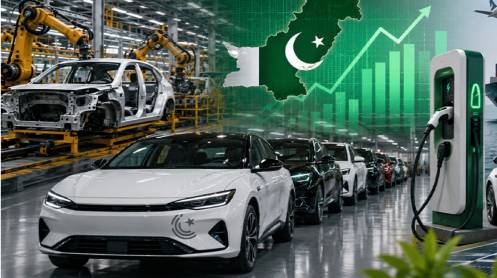
ISLAMABAD: Pakistan’s Federal Board of Revenue (FBR) has extended the sales tax exemption on imported CKD kits for specified electric vehicles (EVs) until June 30, 2027, providing another year of policy continuity for the local EV industry.
Under the 2026–27 budget instructions, the exemption that was due to expire on June 30, 2026, has been extended for one year. Specified EVs will also continue to benefit from the reduced 1% sales tax rate until June 30, 2027.
The government has additionally retained reduced sales tax treatment for electric trucks in CBU condition and electric buses, as part of efforts to encourage cleaner transportation.
FED exemption extended, but luxury EVs face new tax
The FBR has also extended the exclusion of electric vehicles from Federal Excise Duty (FED) until June 30, 2027.
However, a new FED structure has been introduced for luxury electric vehicles:
30% FED on EVs valued above US$75,000 and up to US$110,000
40% FED on EVs valued above US$110,000
This means mainstream EVs and locally assembled vehicles can continue to benefit from preferential taxation, while high-end imported electric cars and SUVs will face significant additional taxation.
What it means for Pakistan’s EV market
The measure is broadly positive for Pakistan’s emerging EV manufacturing sector. Extending the CKD-kit exemption to 2027 gives manufacturers and investors greater certainty for local assembly, while the 1% sales tax regime helps keep qualifying EVs competitive with conventional vehicles.
At the same time, the new FED on luxury EVs indicates that the government’s tax policy is becoming more targeted—supporting mass-market and clean mobility while increasing taxation on expensive electric vehicles.
For the EV industry, the key takeaway is policy continuity through June 30, 2027, particularly for CKD imports, electric buses and qualifying locally assembled EVs.
Story by Sohail Sarfaraz