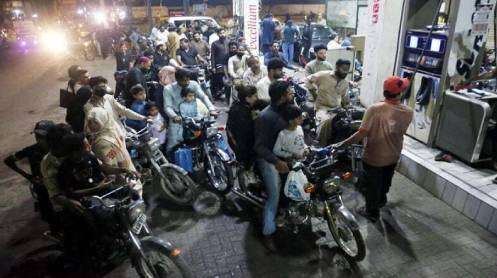
ISLAMABAD: The Petroleum Division has proposed a Rs75 billion Fuel Relief Scheme for three months to provide targeted relief of Rs100 per litre to around 11.8 million users of motorcycles, three-wheelers and cars up to 800cc amid a sharp rise in petroleum prices triggered by the Gulf crisis.
According to a summary submitted to the Economic Coordination Committee (ECC) of the Cabinet, the proposed scheme would provide monthly relief of up to Rs2,000 for two- and three-wheeler users and Rs3,000 for users of cars up to 800cc.
Under the proposed mechanism, motorcycle and three-wheeler users would receive relief on up to 20 litres of petrol per month, while eligible small-car users would qualify for relief on up to 30 litres.
The Petroleum Division estimates that approximately 10 million two-wheeler users, 0.8 million three-wheeler users and one million small-car users would benefit from the initiative.
The estimated monthly fiscal impact has been placed at Rs24.6 billion, comprising Rs20 billion for two-wheelers, Rs1.6 billion for three-wheelers and Rs3 billion for cars up to 800cc.
Petrol Price Rises by Rs105 Since March
The proposal comes amid a substantial increase in domestic petroleum prices. The Petroleum Division noted that petroleum prices had already risen considerably over the past six months, while international oil prices witnessed an unprecedented surge in recent days.
According to the summary, between July 1 and September 11, 2026, petrol prices increased by Rs72 per litre, or 24 percent, while High-Speed Diesel (HSD) rose by Rs87 per litre, or 28 percent.
On September 11 alone, both petrol and HSD prices increased by Rs11.13 per litre.
Petrol, which was priced at Rs266 per litre on March 1, rose to Rs299 on July 1 and reached Rs371 per litre on September 11, representing a cumulative increase of Rs105 per litre.
Similarly, HSD increased from Rs281 per litre on March 1 to Rs311 on July 1 and further to Rs398 per litre on September 11, marking a cumulative increase of Rs117 per litre.
The Petroleum Division said higher fuel prices were creating a severe economic shock, particularly for lower-income groups, while also contributing to broader inflationary pressures.
“There is visible public pressure and simmering unrest,” the division observed, stressing the need for policy intervention.
Following this situation, the Prime Minister directed the authorities to develop a mechanism to provide relief to the poorest segments of society.
A series of consultations were subsequently held under the leadership of the Deputy Prime Minister, involving the Petroleum, Economic Affairs and IT & Telecom ministries, along with senior officials from the Finance Division, Petroleum Division, OGRA and the State Bank of Pakistan.
Relief Linked to User, Not Vehicle Owner
Under the proposed mechanism, relief would be provided to the actual user of the vehicle rather than its registered owner. Each user would be allowed to claim relief for only one vehicle.
The system would use the user’s CNIC, vehicle registration number and mobile phone number as key controls to prevent duplicate or multiple claims.
The Petroleum Division estimates that the total registered base of relevant vehicles is around 34 million. After applying an assumed retirement rate of 40 percent, the operational two-wheeler population has been estimated at approximately 20.6 million.
Based on the experience of an earlier relief programme, the government estimates that around 10 million two-wheeler users could benefit from the proposed scheme.
Digital Fuel Pass System Proposed
A major component of the initiative is the proposed Digital Fuel Pass System (FPS), which would manage registration, token issuance, validation and settlement, third-party verification, SMS services and other operational requirements.
The government has sought Rs75 billion through a Technical Supplementary Grant (TSG) in favour of the Ministry of Petroleum under Demand No. 36 to finance the Fuel Relief Scheme.
An additional Rs1.73 billion TSG has been proposed for the Ministry of IT and Telecom to operationalise the Fuel Pass System.
The additional funding would cover technology solutions, call-centre operations, SMS services, FPS software development and deployment, registration and token-issuance modules, validation and settlement systems, third-party verification and other related expenditures.
The Ministry of IT and Telecom and its relevant entities may also be authorised to undertake the required procurement under applicable rules to operationalise the system.
The summary has been jointly finalised by the Petroleum Division and Ministry of IT and Telecom and circulated to the Finance Division, State Bank of Pakistan and OGRA for their comments.
The proposals, including the Rs75 billion funding for the relief scheme, Rs1.73 billion for the digital system and related implementation arrangements, have now been submitted to the ECC for consideration and approval.
Story by Mushtaq Ghumman