
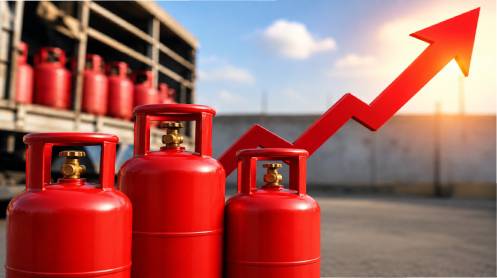
ISLAMABAD: Liquefied petroleum gas (LPG) industry stakeholders have urged the government to replace monthly price notifications with weekly or daily adjustments and reconsider the linkage with Saudi Aramco’s Contract Price (CP), as border closures and rising transportation costs drive domestic prices higher ahead of winter.
The demand follows the closure of the Rahimdad-250 border post, which has disrupted LPG supplies and increased the risk of hoarding, black marketing and artificial price hikes, particularly in remote and hilly areas where consumers depend heavily on the fuel.
Industry representatives argue that Pakistan’s LPG pricing framework, largely unchanged for more than a decade, no longer reflects prevailing market conditions. Although domestic prices are benchmarked to Saudi Aramco’s CP, much of Pakistan’s imported LPG originates from Iran, Oman, the United Arab Emirates and Iraq.
They contend that advance monthly price notifications issued by the Oil and Gas Regulatory Authority (Ogra) discourage major state-owned enterprises (SOEs) from importing LPG when international prices and transportation costs diverge from the official benchmark, leaving the market increasingly dependent on private importers and land-route supplies.
The situation has been further complicated by the Ministry of Commerce’s October 16 memorandums withdrawing electronic import form (EIF) exemptions for Iranian imports and shipments destined for Central Asian Republics and Azerbaijan through Iran. More than 4,500 tonnes of LPG are reportedly stranded on the Iranian side of the border.
Pakistan consumes approximately two million tonnes of LPG annually, with domestic production accounting for around 30 per cent and imports supplying the remaining 70 per cent. Of the approximately 1.2 million tonnes imported each year, nearly 250,000 tonnes arrive through Port Qasim, while around one million tonnes are reportedly transported through Iranian routes, including Taftan, Mand and Rahimdad-250.
The Taftan crossing has remained closed for nearly six months because of security concerns, while Mand has experienced intermittent disruptions, increasing dependence on Rahimdad-250.
Mohammad Ali Haider, vice chairman of the LPG Marketing Association, which represents more than 200 companies, said LPG prices had increased by Rs100 per kilogram over the weekend following the withdrawal of the trade exemption. He warned that rates could rise further without immediate government intervention.
According to Haider, Iranian auctioned LPG previously reached the border at $100–150 per tonne below Saudi Aramco’s CP before the war. However, higher insurance premiums and freight charges associated with the conflict have reportedly pushed costs to around $300 per tonne above the benchmark, making Ogra’s notified prices increasingly disconnected from actual import costs.
He argued that petroleum product prices had shifted towards daily adjustments following the outbreak of the war, whereas LPG continued to be governed by advance monthly notifications that did not adequately reflect changing market conditions.
Haider said major state-owned companies, including Sui Southern Gas Company (SSGC), Sui Northern Gas Pipelines Limited (SNGPL) and Pak-Arab Refinery Limited (PARCO), were reluctant to import LPG at notified rates because of concerns about potential accountability investigations if actual procurement costs exceeded the official benchmark.
Border disruptions have also diverted pressure towards Gwadar, where freight costs have reportedly increased from $60–80 to as much as $380 per tonne. Haider alleged that manipulated freight arrangements, questionable import declarations and the absence of digital tracking for tankers, transporters and distributors were facilitating profiteering and tax evasion.
He also criticised a Petroleum Division directive requiring state-owned enterprises to auction locally produced LPG against signature bonuses, arguing that the mechanism favoured companies with greater financial resources.
Pakistan Petroleum Limited had previously allocated LPG through a transparent bidding process, offering monthly quotas of 25 tonnes to successful bidders. However, a relatively little-known company reportedly offered a signature bonus of Rs220 million for a five-tonne quota, prompting allegations of possible money laundering and consumer exploitation. The process has since been stalled by litigation.
The association has called for a comprehensive review of the LPG policy in consultation with industry stakeholders, revision of the marketing margin of Rs35,000 per tonne fixed in 2016, digital monitoring of imports and distribution, and publication of daily LPG prices on Ogra’s website.
Haider also questioned the effectiveness of a petroleum levy of Rs4,690 per tonne introduced in 2016 to cushion consumers against price shocks, arguing that it was not delivering its intended benefits.
Industry stakeholders maintain that a more responsive pricing mechanism, stronger regulatory oversight and improved supply-chain transparency are essential to prevent artificial shortages and protect consumers as winter demand increases.
Story by Khaleeq Kiani