
Lightweight, flexible and semi-transparent perovskite photovoltaics could expand solar deployment across buildings, vehicles, agriculture and smart electronics.
Thank you for reading this post, don't forget to subscribe!Solar energy is moving beyond conventional rooftops and utility-scale installations as next-generation photovoltaic technologies open up new opportunities for renewable power generation. While traditional silicon solar panels remain a proven solution, their weight, rigidity and opaque design can limit their use in certain buildings, vehicles and other applications. Perovskite photovoltaics (PV) offer an alternative, with the potential to transform previously unsuitable surfaces into energy-generating structures.
According to IDTechEx’s report, Perovskite Photovoltaics 2027–2037: Technologies, Markets & Trends, the technology’s commercial potential extends beyond high-efficiency perovskite-silicon tandem cells. Single-junction and flexible perovskite devices are also attracting attention for specialised applications where lightweight construction, flexibility and adjustable transparency are important.
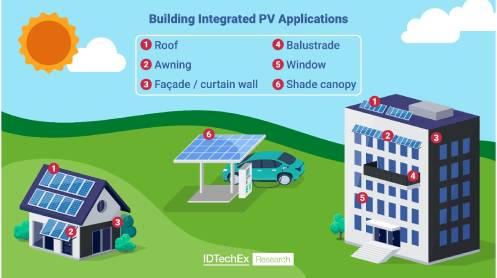
One promising area is building-integrated photovoltaics (BIPV), where solar cells are incorporated into building materials such as windows, façades and roofing. Lightweight perovskite modules could also offer opportunities for industrial warehouses and commercial facilities with roofs that cannot support the additional weight of conventional solar installations. However, practical deployment will depend on durability, weather resistance, service life and installation costs.
Perovskite PV could also support the development of agrivoltaics, where solar generation is combined with agricultural activities. By adjusting light transmission, semi-transparent solar cells may allow suitable amounts of sunlight to reach crops while generating electricity. Other potential applications include vehicle-integrated photovoltaics (VIPV), roadside noise barriers and other infrastructure surfaces that offer limited opportunities for conventional solar panels.
At a smaller scale, indoor perovskite photovoltaics could provide power for Internet of Things (IoT) devices, smart sensors and connected electronics. These devices often operate under artificial lighting and require relatively little energy, making indoor PV a potential alternative to disposable batteries in selected applications.
The commercial outlook for perovskite technology is becoming increasingly specialised. Rather than competing with silicon solely on conversion efficiency, different perovskite designs are being developed to meet the requirements of specific markets. Flexible devices, semi-transparent modules and tandem cells each offer distinct advantages, depending on the intended application.
Despite this potential, several challenges remain, including long-term stability, moisture and heat resistance, manufacturing scalability and the management of lead-containing materials in many perovskite formulations. Addressing these issues will be essential to achieving reliable performance and widespread commercial adoption.
IDTechEx’s research examines technology development, manufacturing dynamics, cost structures, industry participants and emerging market trends. It also assesses developments from material innovations and pilot production lines to commercialisation strategies, providing insights into the technology’s anticipated evolution over the next decade.
As the solar industry expands beyond conventional power plants and rooftops, perovskite photovoltaics could create new opportunities for integrating renewable energy into everyday structures and devices. IDTechEx’s report, Perovskite Photovoltaics 2027–2037: Technologies, Markets & Trends, provides a detailed analysis of nine application sectors, including market value and capacity forecasts, to help technology developers, investors and end-users assess the opportunities ahead.