
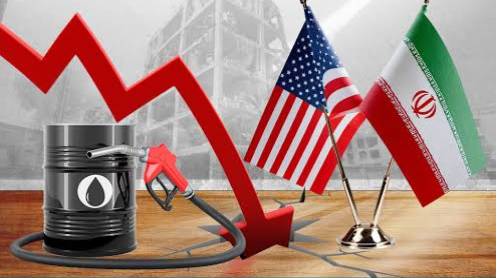
LONDON: Global oil prices declined for a fourth consecutive day on Thursday as investors assessed the possibility of reduced tensions in the US-Israeli conflict with Iran following electoral setbacks for US President Donald Trump’s Republican Party in congressional elections.
Thank you for reading this post, don't forget to subscribe!Brent crude futures fell 80 cents, or 0.85%, to $93.82 per barrel by 0426 GMT, while US West Texas Intermediate (WTI) crude declined $1.20, or 1.36%, to $86.92 per barrel.
Both benchmarks had plunged more than 8% in the previous trading session, settling at their lowest levels since August 31.
Market sentiment improved amid expectations that a weakened Trump administration, facing a Democratic-controlled Congress with greater capacity to constrain its military options, could be more inclined to pursue a diplomatic settlement with Iran.
Two sources close to Gulf government circles said on Wednesday that the possibility of a full-scale US assault on Iran appeared less likely, as Washington could face greater political pressure to seek a negotiated solution.
An end to the conflict could restore oil supplies from the Middle East that have been disrupted by the war. However, analysts cautioned that the diplomatic path remained uncertain and further price volatility could not be ruled out.
“Markets are assessing the impact of the midterm elections on Donald Trump’s next steps with the Iran war, pricing in a higher likelihood for the war to end,” said June Goh, senior oil analyst at Sparta Commodities.
She added that significant uncertainty remained over the prospects for a diplomatic settlement, while global strategic oil reserves had been substantially depleted.
Meanwhile, crude shipments through the Strait of Hormuz, a critical waterway for global oil supplies from the Gulf, have recovered to near pre-war levels, although transportation costs remain elevated.
The restoration of Gulf oil supplies has pushed the global petroleum market back into surplus following months of disruption, according to JPMorgan. The bank estimated that the market returned to a surplus of 1.1 million barrels per day in September, widening to 1.4 million barrels per day in October, close to last year’s average of 1.3 million barrels per day.
Despite the recent decline in prices, uncertainty persists over the potential direction of US policy before the Democratic-controlled Congress takes office in January.
Citi said in a research note on Thursday that the White House could use its executive powers in foreign policy following the midterm elections, potentially increasing the risk of further escalation with Iran.
Eurasia Group revised its assessment of the conflict, lowering the probability of renewed US strikes on Iran to 60% from 65%. However, it also reduced the likelihood of a diplomatic agreement to 10% from 20%, citing Iran’s firm negotiating position and Trump’s reluctance to accept terms that could be perceived as a defeat.
The consultancy increased the probability of a prolonged standoff to 30% from 15%.
Eurasia Group warned that any renewed escalation could push Brent crude prices sharply higher, potentially reaching $110 to $125 per barrel.
Mukesh Sahdev, chief executive of energy consultancy XAnalysts, said commercial oil inventories in major consuming countries were close to their lowest levels in 15 years. He added that Iran could emerge from the US election outcome with greater resolve, creating further uncertainty for global energy markets.
Adding to market concerns, the US Energy Information Administration (EIA) reported on Wednesday that American crude oil, gasoline and distillate inventories had all declined during the previous week, while demand reached its highest level in a year.
The combination of geopolitical uncertainty, recovering Gulf supplies and declining US inventories is expected to keep global oil markets sensitive to developments in the Middle East and Washington’s policy towards Iran.
By Reuters