KARACHI: The Institute of Business Administration (IBA) Karachi hosted the Sixth Annual International Conference on Business and Economic Research (CBERCON 2026), bringing together leading academics, policymakers, industry experts and students to explore pathways for Pakistan to overcome its interconnected economic, climate and governance challenges.
Thank you for reading this post, don't forget to subscribe!Organised by IBA’s Centre for Business and Economic Research (CBER), the two-day conference was held under the theme “Beyond Polycrisis: Pathways Towards a Sustainable Economic Future”, in partnership with the World Bank Group, Sindh Higher Education Commission, NOWPDP, Dawn Media and Avari Towers.
In his opening remarks, IBA Karachi Executive Director Dr. S. Akbar Zaidi described Pakistan’s economic, climate, population and political challenges as interconnected crises. He highlighted that economic growth had remained only marginally above population growth for years, identifying climate change and population expansion as two critical challenges requiring greater attention. He noted that Pakistan’s population of approximately 250 million is projected to reach 270 million by 2030.
Dr. Yaqoob Khan Bangash, Professor and Dean of SESS, observed that while Pakistan had demonstrated resilience through repeated crises, survival should not be mistaken for progress. He emphasised the need to move beyond managing crises towards developing sustainable solutions.
The opening keynote was delivered by Prof. Adil Najam, Dean Emeritus and Professor at Boston University’s Frederick S. Pardee School of Global Studies and President of WWF International. Speaking on “Climate Change and the Age of Adaptation”, he stressed that climate change must be integrated into policymaking across water, health, education and infrastructure rather than treated as an isolated environmental issue.
Prof. Iwi Ugiagbe-Green, Professor of Equity in Education and Academic Director (STRIVE) at Manchester Metropolitan University, UK, revisited Keynes’s economic vision and argued that prosperity should be measured through human well-being and the planet’s ability to sustain life.
The first day also featured a leadership session with Zafar Masud, President and CEO of Bank of Punjab, focusing on resilience and ethical leadership, alongside a discussion featuring former federal ministers Umar Saif and Miftah Ismail. A sustainability-themed theatre performance by Kaifiyat Collective was also presented.
Welcoming participants on the second day, Dr. Lubna Naz, Professor and Director of CBER, emphasised that moving beyond multiple interconnected crises required research-driven solutions linking economic resilience, climate action and inclusive growth.
Federal Minister for Climate Change and Environmental Coordination Senator Musadik Malik, in his address, highlighted Pakistan’s recurring economic challenges, comparing the country’s growth trajectory to a kite running out of string due to foreign exchange constraints. He stressed that the impact of climate disasters should be measured not only through GDP losses but also through human lives and livelihoods. He also urged students to apply their knowledge to addressing national challenges.
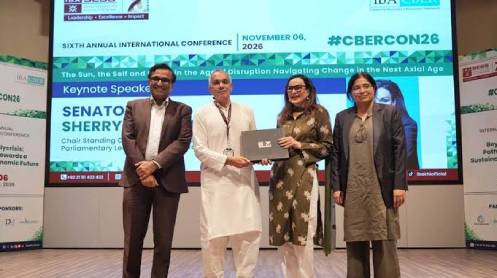
Senator Sherry Rehman, Chair of the Senate Standing Committee on Climate Change, delivered a keynote titled “The Sun, the Self and Power in the Age of Disruption”. She highlighted Pakistan’s rapid transition towards solar energy, estimating that renewable energy adoption helped the country avoid approximately $12 billion in fossil fuel and LNG imports between 2018 and 2026.
She also discussed the emergence of a multipolar global order, Pakistan’s position as a credible middle power and the growing influence of artificial intelligence, cautioning against allowing algorithms to replace human decision-making. She encouraged young people, particularly women, to strengthen their participation in public life.
The conference featured a series of panel discussions covering job creation, evidence-based policymaking, gender and water conflicts, populism and political stability, artificial intelligence in economic policy, and climate-related loss and damage from floods in South Asia.
A Grand Dialogue on trade and tariff reforms, alongside parallel technical sessions, provided researchers and experts with opportunities to present new findings and exchange perspectives on Pakistan’s economic and development challenges.
The two-day conference concluded with audience reflections, reaffirming IBA Karachi’s commitment to bridging research and policymaking and preparing the next generation of leaders to help steer Pakistan towards a more resilient, inclusive and sustainable economic future.