
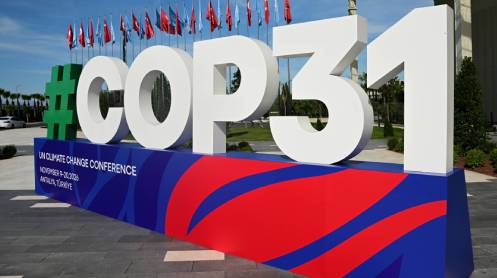
ANTALYA: Leaders at the COP31 climate summit have called on governments worldwide to accelerate efforts to combat global warming, warning that rising temperatures and increasingly severe climate-related disasters demand urgent action.
Thank you for reading this post, don't forget to subscribe!The appeal came as the two-week United Nations climate conference opened in Turkey on Monday, with world leaders and climate officials urging countries to prioritise climate action despite competing international challenges, including wars, inflation and the rapid expansion of artificial intelligence.
UN Climate Change Executive Secretary Simon Stiell said the urgency of the climate crisis must drive governments towards faster and more ambitious action, stressing that current progress remained far below what was required.
A United Nations Environment Programme report published in October warned that the world was already on course to exceed the 1.5-degree Celsius warming threshold established under the 2015 Paris Agreement, raising concerns about the increasingly severe consequences of climate change.
A separate UN report released on Monday indicated that 2026 was on track to become one of the four hottest years on record, with a powerful El Niño contributing to rising global temperatures.
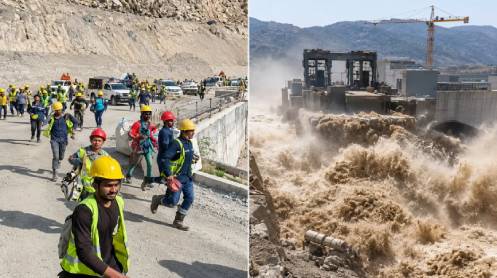
The year has also witnessed extreme heatwaves across Western Europe and devastating climate-related disasters, including a glacier collapse in Nepal that triggered catastrophic flooding, killing more than 1,450 people, with thousands still missing.
ELECTRIFICATION TAKES CENTRE STAGE
Under Turkey’s COP31 presidency, this year’s summit is focusing on accelerating the electrification of the global economy, with a target of increasing the share of electrified economic activity to more than one-third by 2035, compared with approximately one-fifth today.
The Turkish presidency is encouraging countries to support the proposed target through a new international pledge.
The initiative aims to reduce greenhouse gas emissions by accelerating the transition from fossil-fuel-powered vehicles, heating systems, industrial equipment and household appliances towards electricity-based alternatives.
COP31 President Murat Kurum said climate negotiations should deliver tangible improvements in people’s daily lives through energy-efficient buildings, cleaner public transport, affordable energy and employment opportunities.
However, climate advocates have raised concerns that the electrification initiative does not explicitly require additional electricity to come from low-carbon sources, potentially limiting its climate benefits.
Turkish President Tayyip Erdogan also called for concrete outcomes, urging participating countries to translate their climate commitments into practical action rather than leaving them as promises on paper.
WARS AND AI ADD TO ENERGY CHALLENGES
Geopolitical tensions and conflicts are emerging as major challenges for global climate efforts, highlighting the world’s continued dependence on fossil fuels.
The Iran war has severely disrupted oil shipments through the Strait of Hormuz, pushing up international fuel prices and prompting countries to seek alternative energy supplies. Russia’s invasion of Ukraine has also exposed vulnerabilities in global energy markets.
Meanwhile, the United States under President Donald Trump has continued to promote expanded oil, gas and coal production, while several Asian economies, including South Korea, India and Thailand, have increased their reliance on coal or taken steps to strengthen coal-fired power generation.
John Holdren of Harvard University, who served as a science adviser to former US President Barack Obama, observed that geopolitical developments had strengthened arguments in favour of continued fossil fuel consumption.
At the same time, renewable energy deployment has continued to expand, supported by growing exports of affordable clean-energy technologies from China.
Stiell argued that renewable energy offers a clear pathway towards stronger energy security, pointing to the economic damage caused by volatile fossil fuel prices. He said renewable energy installations had already generated savings worth hundreds of billions of dollars for the global economy.
The rapid expansion of artificial intelligence is another emerging challenge for climate policymakers, as growing data centre operations and computing requirements are driving up global electricity demand and potentially increasing greenhouse gas emissions.
Turkey is expected to encourage governments, businesses and other institutions to endorse a separate pledge outlining principles for the sustainable development and deployment of artificial intelligence.
Chris Bowen, Australia’s president of COP31 negotiations, expressed hope that the conference would demonstrate the importance of international cooperation in addressing global challenges.
He urged delegates to ensure that the current generation rises to the climate challenge and delivers meaningful progress for future generations.