
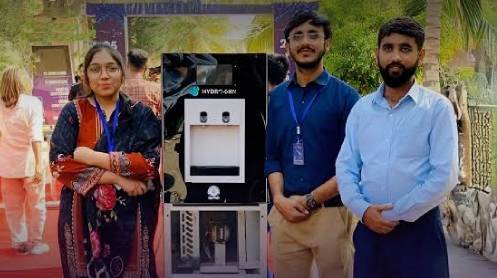
KARACHI: Amid Pakistan’s persistent energy challenges, rising fuel prices and increasing industrial production costs, a group of young engineers in Karachi has developed a locally manufactured hydrogen generator that could offer an alternative source of heat for industrial, commercial and domestic applications.
Thank you for reading this post, don't forget to subscribe!The startup, PakHydro, has developed an electrolysis-based system that uses water to produce hydrogen gas, which can subsequently be used as fuel for generating flames and heat. The technology aims to reduce dependence on conventional fuels, including natural gas and liquefied petroleum gas (LPG).
The prototype uses electrolysis to separate water into hydrogen and oxygen, with the hydrogen produced available for immediate use. The developers believe the system could have applications in metal fabrication, welding, textile manufacturing, bakeries, traditional ovens and other businesses requiring a regular supply of heat.
The project is being led by Muhammad Ayan, an electrical engineering student at Sir Syed University of Engineering and Technology and founder and CEO of PakHydro.
The team also includes Dr Usman Alauddin, co-founder and Chief Technology Officer, who is a professor in the Department of Mechanical Engineering at NED University, and Amir Ali, co-founder and Chief Operating Officer, who serves as an assistant professor in the Department of Electrical Engineering at Sir Syed University.
According to Dr Usman Alauddin, the current prototype is claimed to produce one kilogramme of hydrogen in approximately six to eight minutes using around eight to 10 litres of water. He said the system’s electricity consumption and production costs would vary depending on its capacity and operating conditions.
He added that the generator could also be powered through renewable energy sources, particularly solar electricity, potentially creating opportunities for integrating hydrogen production with solar energy systems.
The developers see considerable potential for the technology in Pakistan’s industrial and commercial sectors, where rising prices of natural gas, LPG and other conventional fuels have placed additional pressure on businesses.
Dr Usman Alauddin said the commercial introduction of the technology could help establish a new domestic industry involving the manufacturing, installation, maintenance and servicing of hydrogen torch systems.
Based on preliminary estimates, he suggested that the potential market could reach Rs40 billion to Rs50 billion, with the possibility of generating between 8,000 and 10,000 employment opportunities.
Founder Muhammad Ayan said the team had conducted several experiments and developed different designs before arriving at the current prototype. Initial research focused on different cell technologies, followed by continuous research and development to create a locally developed system capable of producing hydrogen according to demand.
He said a major achievement was that the basic components of the system had been manufactured or sourced locally, creating opportunities to develop domestic manufacturing capabilities, technical expertise and supply chains.
Ayan explained that the technology operated on a “gas-on-demand” principle, producing hydrogen according to immediate requirements rather than depending on the storage of large quantities of fuel gas.
The startup now plans to expand the technology beyond industrial torches and explore its use in domestic and commercial appliances, including cooking stoves, heating systems and other equipment requiring flames or heat.
The team is also examining the possibility of developing smaller units for remote and mountainous areas, where access to conventional energy supplies can be limited.
However, the technology’s commercial viability will depend on further technical validation, particularly its electricity consumption, overall energy efficiency, production costs, operational reliability and compliance with hydrogen safety standards.
If successfully developed and commercialised, PakHydro’s innovation could open new opportunities for indigenous engineering, clean-energy research and alternative industrial heating solutions in Pakistan.
Story by Kashif Hussain