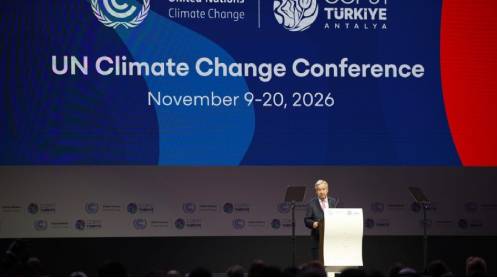
ANTALYA: United Nations Secretary-General António Guterres has called for the development of a global near-zero methane standard for the oil and gas industry, urging governments, energy producers, investors and buyers to take stronger action against methane emissions and growing waste pollution.
Thank you for reading this post, don't forget to subscribe!Addressing the COP31 Leaders’ Roundtable on Zero Waste, Circularity and Methane in Antalya, Türkiye, on November 11, Guterres asked the United Nations Environment Programme (UNEP) to develop a credible, science-based global benchmark based on robust measurement, reporting and verification.
He stressed that voluntary action was no longer sufficient to address methane pollution, particularly in the fossil fuel sector, which has the technology, resources and responsibility to reduce emissions rapidly.
“The fossil fuel industry has the means, the technology and the responsibility to cut fastest. Yet its methane emissions are still rising,” Guterres said, expressing concern over the rollback or delay of regulations aimed at controlling emissions.
Highlighting the scale of global waste pollution, the UN Secretary-General said the world generates more than 2 billion tonnes of municipal waste annually, while the equivalent of 2,000 garbage trucks full of plastic is dumped into oceans, rivers and lakes every day.
He also warned that electronic waste is growing five times faster than it is being recycled, while billions of people worldwide still lack access to basic waste collection services.
According to Guterres, inadequate waste management is creating serious environmental and public health challenges, including air pollution from open burning, contamination of water and soil, and the spread of microplastics into food and drinking water.
He described food waste as particularly unacceptable, noting that enough food for approximately one billion meals is discarded every day while hundreds of millions of people continue to face hunger.
The UN chief further highlighted the significant contribution of waste to global greenhouse gas emissions, stating that food loss and waste account for 8-10% of global emissions. Waste and wastewater also contribute around one-fifth of human-caused methane emissions.
Methane, he noted, is responsible for nearly one-third of current global warming, making its reduction one of the fastest ways to limit the overshoot of the 1.5°C temperature threshold.
Guterres recalled launching a Call to Action on Methane in June, covering the waste, agriculture and fossil fuel sectors, and urged countries to strengthen their efforts to reduce emissions.
He revealed that approximately 167 billion cubic metres of natural gas were flared in 2025, representing an estimated economic loss of $54 billion and causing significant environmental damage.
He added that around 30% of methane emissions from fossil fuels could be eliminated at no net cost. Satellite monitoring has also improved the ability to identify major methane leaks.
Since 2023, UNEP’s Methane Alert and Response System has issued more than 5,000 alerts, but barely one in eight has received a response, highlighting the gap between identifying pollution and taking corrective action.
Calling for stronger accountability, Guterres urged governments to enforce effective regulations and introduce incentives for preventing, recovering and responsibly managing waste. He also called on oil and gas producers to end routine flaring and venting, repair methane leaks, and improve emissions monitoring.
Buyers were encouraged to demand verified methane reductions, while investors were urged to make methane performance an important factor in investment decisions.
Highlighting the economic opportunities of a circular economy, Guterres said practical zero-waste solutions were already delivering results across the world. Japan has reduced food waste by more than half, while cities including Durban, Dhaka and Kampala are converting organic waste into compost, fertiliser and animal feed, reducing costs and creating employment opportunities.
He added that the circular economy could generate a net economic gain of more than $100 billion annually by 2050.
Outlining the priorities for global action, the Secretary-General called for halving food waste by 2030, ending open dumping and burning, capturing methane from landfills and wastewater, designing longer-lasting products and making manufacturers responsible for the waste generated by their products.
He also urged countries to conclude an ambitious global treaty to end plastic pollution and ensure that cities receive adequate financing for waste collection, composting and circular infrastructure.
Commending Türkiye’s leadership in the Zero Waste movement, Guterres thanked First Lady Emine Erdoğan for her continued efforts and leadership, including her role as Chair of his Advisory Board, and praised the country’s initiative to make COP31 a Zero Waste COP.
Concluding his address, Guterres emphasised that zero waste was not merely an environmental objective but also an opportunity to improve public health, create decent jobs, protect natural resources and strengthen economic development.
“Let us move from managing waste to preventing it, shift to a circular economy – and end the age of unchecked methane pollution,” he urged world leaders.