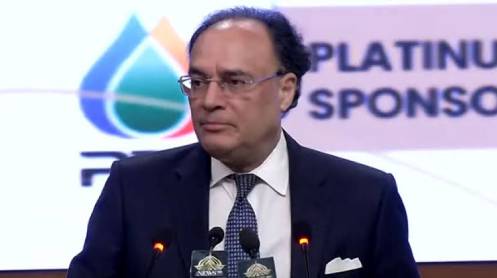
ISLAMABAD: Federal Finance Minister Muhammad Aurangzeb has described Pakistan’s minerals and mining sector as a potential game-changer for the national economy, saying it could emerge as one of the country’s leading drivers of sustainable, export-led economic growth and foreign investment.
Thank you for reading this post, don't forget to subscribe!Addressing the two-day Pakistan Minerals Investment Forum (PMIF) 2026 in Islamabad on Thursday, Aurangzeb said the government was pursuing deep structural reforms to move the economy away from repeated cycles of short-lived, consumption-driven expansion followed by balance of payments crises.
He identified privatisation, public finance management, pension and tariff reforms, and the transition towards a cashless economy as key pillars of the government’s economic reform agenda.
The forum brought together international investors, government officials and industry representatives to explore investment opportunities in Pakistan’s mineral resources, with provincial leaders presenting development plans, incentives and potential projects.
Aurangzeb said the mining sector offered significant opportunities to attract foreign direct investment and expand sustainable exports. He noted that a major mining project was expected to generate approximately $2.8 billion in export proceeds once it became commercially operational.
Acknowledging delays in the project’s implementation, he expressed confidence in its financing arrangements, saying it had secured the largest syndicated financing in Pakistan’s history and that its financial partners remained committed to moving forward.
“When we talk about a game-changer, when we talk about a step change in terms of moving towards sustainable growth, minerals and mining is going to be one of the most important, if not the most important sector, which is going to take us towards sustainable growth,” he said.
The finance minister assured investors that the Ministry of Finance would extend its full support and facilitate the development of the sector, emphasizing its importance to Pakistan’s long-term economic prospects.
He cautioned against repeating the country’s historical pattern of achieving economic stabilisation before reverting to consumption-led growth, which eventually creates pressure on foreign exchange reserves and the balance of payments.
Aurangzeb said Pakistan’s economy had recovered from contraction in recent years, recording growth of around 2 per cent and subsequently 3 per cent. Growth in the previous fiscal year remained slightly below 3.7 per cent, while the government was targeting 4 per cent for the current fiscal year.
He stressed that economic expansion must be driven by exports rather than excessive liquidity and domestic consumption.
“We are very determined; we are not going to repeat that cycle. And therefore, it has to be sustainable growth,” he said.
Highlighting government measures to support exporters, Aurangzeb said the federal budget announced in June included incentives and tax reductions for the export sector, although further reforms were necessary.
He added that export financing rates had been reduced to between 4.5 and 6 per cent and would remain within this range irrespective of the State Bank of Pakistan’s policy rate, which stood at 12 per cent.
Tariff reforms were another important element of the government’s economic strategy, he said, adding that relevant federal ministers were leading discussions on reforms in the energy sector.
The minister also highlighted the growing contribution of information technology exports, projecting that IT export services could reach approximately $5 billion during the current fiscal year.
He said the sector was already contributing to Pakistan’s external account position and providing another avenue for sustainable economic growth.
Investment Climate and Privatisation
Discussing the investment climate, Aurangzeb said attracting foreign direct investment required a combination of macroeconomic stability, institutional reforms and investor confidence rather than relying solely on investment promotion efforts.
Drawing on his experience in the banking sector, he identified macroeconomic stability as a fundamental prerequisite for attracting international investors.
He said investors needed confidence that they could freely bring capital into Pakistan, repatriate profits and dividends, and withdraw their investments when required without unnecessary administrative hurdles involving the State Bank or Ministry of Finance.
The finance minister also stressed the importance of building confidence among domestic investors before seeking substantial foreign investment.
“If the local investors are not showing their trust and confidence, it’s very difficult to convince some of you who have come from different regions and different parts of the world,” he said.
In this regard, he highlighted the importance of the Pakistan International Airlines (PIA) privatisation process, describing it as a significant test of the government’s commitment to structural reforms and its ability to restore investor confidence.
Aurangzeb said 26 state-owned entities had been handed over to the Privatisation Commission, adding that the PIA transaction was particularly important both in terms of its scale and its broader implications for Pakistan’s investment environment.
He emphasized that the government’s current reform approach differed from previous efforts because it was focused on implementing deep structural changes and maintaining consistency in their execution.
The finance minister reiterated that minerals and mining, alongside other export-oriented sectors, would be central to Pakistan’s efforts to achieve sustainable economic growth, strengthen foreign exchange earnings and attract long-term international investment.