
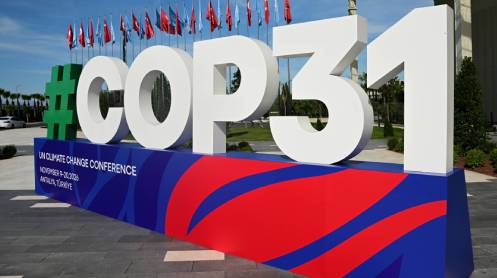
ANTALYA: More than 100 national leaders gathered on the second day of the COP31 World Leaders’ Summit in Antalya, Türkiye, to accelerate global efforts towards building climate-resilient cities, improving energy efficiency and mobilising investment in sustainable infrastructure.
Thank you for reading this post, don't forget to subscribe!The discussions focused on translating national climate commitments into practical action, with particular emphasis on protecting urban communities from growing climate risks, including floods, extreme heat and infrastructure damage.
At a high-level dialogue on Urban Resilience, Adaptation and Climate Action, convened by the COP31 Presidency and UN-Habitat, leaders explored ways to transform national climate and adaptation plans into investment-ready projects for cities and communities.
COP31 President Murat Kurum emphasised that climate action must deliver tangible benefits where people live, including safer communities, energy-efficient homes, stronger infrastructure and improved protection against climate impacts.
He said cities were at the centre of climate implementation, stressing the importance of bringing governments, investors, businesses and local authorities together to accelerate projects and ensure that climate commitments translate into meaningful results.
Antalya Compact Advances Energy-Efficient Buildings
A major development at COP31 was the endorsement of the Antalya Compact for Energy Efficient Buildings, aimed at accelerating the transition towards more efficient and electrified buildings worldwide.
The initiative supports two COP31 Presidency Global Targets for 2035: achieving a 25 percent reduction in the operational energy intensity of the global building stock and accelerating efficient electrification in buildings under the Presidency’s 35-by-35 target.
The summit also recognised six leading sustainable building projects from around the world, highlighting how improved building design and energy performance can reduce energy consumption and emissions.
The winning projects were selected through two international competitions organised by Türkiye with support from the UN Environment Programme (UNEP)-hosted Global Alliance for Buildings and Construction (GlobalABC), in coordination with the Intergovernmental Council for Buildings and Climate (ICBC).
Meanwhile, the Istanbul Zero Waste Action Platform is advancing waste reduction, reuse, repair and recycling through the establishment of international Zero Waste Districts. Its initial programme covers 20 districts, with the ambition of expanding to 100.
COP31’s Sustainable Urban Resilience Financing Facility (SURFF) is also expected to help countries and cities develop investment-ready projects, attract public and private financing and strengthen local implementation capacity.
Türkiye-China Sign $15 Billion Renewable Energy Cooperation Agreement
Investment and private-sector participation remained central to the summit’s implementation agenda as more than 600 CEOs and senior business leaders representing nearly 300 organisations attended the COP31 Business Forum.
A major announcement was the signing of a renewable energy cooperation agreement between Türkiye and the People’s Republic of China, through China’s National Energy Administration.
The agreement envisages approximately $15 billion in investment in Türkiye, including the development of 7,000 MW of new solar and wind power capacity, energy storage systems and 4,000 MW of electricity transmission capacity.
It will also promote technology transfer and local manufacturing of wind turbine equipment in Türkiye, strengthening the country’s renewable energy industry.
In another initiative, the COP31 Presidency launched the Least Developed Countries Green Industrialization Facilitation Mechanism (LDC-GIF), which aims to connect green industrial projects in least developed countries with technology, technical assistance and financing. Türkiye is leading the initiative, with the UN Technology Bank for Least Developed Countries serving as its secretariat. Ten countries have joined the initial pilot programme.
The Türkiye Industry Decarbonisation Investment Platform (TIDIP) also announced projects eligible to receive up to $250 million from the Climate Investment Funds (CIF), supporting its ambition to mobilise more than $6 billion by 2030.
Additionally, CIF announced up to $190 million in adaptation financing for five countries and one region under its Accelerating Resilience Investments and Innovations for Sustainable Economies (ARISE) programme.
Pacific Nations Lead Climate Resilience Efforts
The vulnerability of Pacific Island nations to rising sea levels and climate change also featured prominently in the summit’s discussions.
Pacific countries are advancing locally driven climate solutions by combining traditional knowledge, scientific research and innovative approaches to strengthen community resilience.
COP31 President of Negotiations Chris Bowen described climate change as an existential threat to the Pacific, warning that it was already putting lives, livelihoods, cultures and the future of nations at risk.
He called for accessible climate financing and practical action at the scale and speed required to address the crisis, emphasising that Pacific nations must have a central role in international climate decisions.
The Pacific Resilience Facility (PRF), established and managed by Pacific leaders, has secured more than $200 million in pledges to support community-centred adaptation and resilience initiatives across Pacific Island countries.
Several countries, including the United Kingdom, Canada, Ireland, Denmark, the Netherlands, Norway, the Republic of Korea, Fiji, Papua New Guinea and the Republic of the Marshall Islands, announced new pledges during 2026.
The Minderoo Foundation also became the facility’s first philanthropic donor at COP31, committing $5 million to support Pacific-led resilience initiatives.
UN Calls for Faster Action on Sustainable Buildings
UNEP Executive Director Inger Andersen welcomed the Antalya Compact, describing it as an important step towards making energy-efficient and resilient buildings a global standard.
She stressed that the window for transforming the buildings sector was narrowing and urged governments to translate commitments into policies, investment and practical solutions that reduce emissions, lower energy bills and deliver long-term benefits.
Similarly, UN-Habitat Executive Director and United Nations Under-Secretary-General Anacláudia Rossbach highlighted the importance of cities in delivering climate commitments.
She called for greater attention to adequate housing, the transformation of informal settlements and slums, and stronger urban resilience, noting that decisions on housing, transport, land and basic services directly influence both emissions and communities’ ability to withstand climate shocks.
Climate Investment Funds CEO Tariye Gbadegesin also emphasised the need for catalytic financing to turn national climate priorities into investment opportunities, saying that countries had clear plans for strengthening resilience but needed financial support to implement them at scale.
The discussions in Antalya reinforced a central message of COP31: achieving meaningful climate progress requires moving beyond commitments towards practical implementation, supported by stronger international cooperation, private-sector investment and financing that reaches vulnerable communities.