

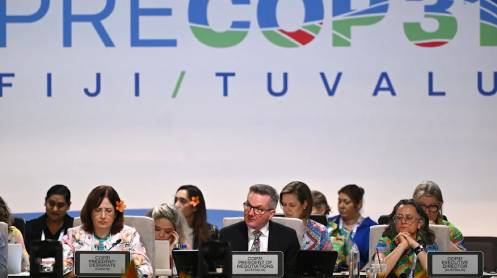
ANTALYA: Countries are facing growing divisions over the future of the 1.5°C global warming target at the COP31 climate summit in Türkiye, as the United Nations warns that breaching the threshold is now imminent and unavoidable.
Thank you for reading this post, don't forget to subscribe!For the past decade, limiting global warming to 1.5°C above pre-industrial levels has remained the central ambition of international climate action. However, with global temperatures already rising by approximately 1.4°C, governments are increasingly divided over how to address the prospect of exceeding the target.
At the midway point of COP31 negotiations in Antalya, vulnerable nations are strongly advocating the retention of the 1.5°C goal, while some negotiating blocs are reportedly pushing to weaken or remove references to it in the final agreement.
Palau President Surangel Whipps Jr, whose Pacific island nation faces existential risks from rising sea levels, stressed that the 1.5°C threshold was not merely an abstract climate objective but a matter of national survival.
He told world leaders that exceeding the threshold threatened the country’s food security, economy and sovereignty.
According to a summary of negotiating positions released by Australia, which is chairing the negotiations, some countries want the final COP31 agreement to reaffirm that 1.5°C remains the appropriate global climate goal.
There are also calls for commitments to return global temperatures to the threshold as soon as possible and recognition that temperatures could eventually decline even after temporarily exceeding it.
Divisions Emerge Over Future of 1.5°C Target
Despite continued public support for the target, some negotiators are privately questioning whether it remains achievable, although many remain reluctant to abandon an objective considered essential for accelerating reductions in greenhouse gas emissions.
Meanwhile, several observers of the closed-door negotiations have warned that some countries are seeking an opportunity to remove or weaken the 1.5°C commitment.
These efforts reportedly involve the Arab Group and Like-Minded Developing Countries, two negotiating blocs representing emerging economies, including Saudi Arabia and India.
A senior Western delegate warned that weakening references to the target could trigger a rollback in international climate commitments.
Jasper Inventor, head of Greenpeace’s delegation at COP31, said some developing countries feared that stronger references to the 1.5°C goal could increase pressure on them to reduce emissions without corresponding financial support from developed nations.
UNEP Overshoot Research Faces Pushback
Another contentious issue involves the scientific research underpinning possible pathways to bring global temperatures back down after temporarily exceeding the 1.5°C threshold.
Some countries have called for the rejection of so-called grey literature, a position viewed by observers as a possible challenge to research published by the United Nations Environment Programme (UNEP).
In September, UNEP released a landmark assessment examining potential global warming overshoot scenarios and exploring how temperatures could potentially return to 1.5°C by 2100 after crossing the threshold.
Outgoing UN Secretary-General Antonio Guterres, who has spent much of his tenure urging governments to preserve the 1.5°C ambition, told COP31 that any temperature overshoot must be as small and short-lived as possible.
Scientists Warn of Severe Climate Consequences
Under the 2015 Paris Agreement, nearly 200 countries committed to keeping global warming well below 2°C while pursuing efforts to limit the increase to 1.5°C.
Subsequent scientific assessments have highlighted the urgency of the lower threshold, warning that climate risks increase substantially beyond 1.5°C.
These include more intense heatwaves, severe flooding and irreversible environmental damage, including the permanent loss of coral reef ecosystems.
However, reversing global warming after exceeding the threshold remains scientifically uncertain.
Pierre Friedlingstein, a climate scientist at the University of Exeter and lead author of the Global Carbon Budget study, said achieving a return to 1.5°C would require rapid reductions in greenhouse gas emissions alongside large-scale carbon removal from the atmosphere.
Potential approaches include restoring forests and wetlands, expanding natural carbon sinks and deploying emerging carbon removal technologies.
The debate at COP31 highlights a growing challenge for international climate diplomacy: maintaining ambitious temperature targets while addressing the financial, technological and political barriers confronting countries in the transition towards a low-carbon future.
By AFP