

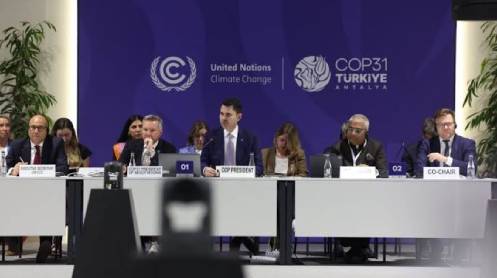
ANTALYA: The COP31 climate conference in Antalya, Türkiye, ended in a major diplomatic deadlock on Sunday after more than two weeks of contentious negotiations, with participating countries failing to reach consensus on an overarching agreement, particularly on a commitment to move away from fossil fuels.
The United Nations climate summit, which extended well beyond its scheduled conclusion, became one of the longest COP conferences in history and marked the most significant breakdown in climate negotiations since COP15 in Copenhagen in 2009.
Climate experts described the outcome as a serious failure of international leadership at a time when global warming is intensifying and climate-related disasters are becoming increasingly severe.
Mohamed Adow, director of the energy think tank Power Shift Africa, described the conference as the worst-ever COP and said its collapse should serve as a wake-up call for the international community.
At the final meeting scheduled to approve the proposed Antalya Pact, it became evident that the more than 190 participating countries could not reach the consensus required to adopt the agreement. The United States was notably absent from the negotiations following President Donald Trump’s withdrawal from international climate action.
Deep divisions over key issues prevented countries from bridging their differences. The most contentious issue was the inclusion of a commitment to transition away from fossil fuels, which was ultimately removed from the proposed agreement. Disagreements over increasing financial assistance for developing countries facing climate-related disasters further complicated negotiations.
Oil-producing nations, including Saudi Arabia, have consistently opposed explicit references to fossil fuels in international climate agreements.
The European Union, Panama, the Marshall Islands and Norway were among the parties that rejected the proposed text. Ireland’s Climate Minister Darragh O’Brien, who helped lead negotiations for the European Union, said the bloc could not support an agreement that did not even mention fossil fuels.
He later told Reuters that the negotiations had been hijacked by some oil-producing countries.
COP31 President Murat Kurum acknowledged that the proposed agreement lacked sufficient support for adoption, saying that despite extensive efforts, there was no consensus among participating countries.
China, the world’s largest greenhouse gas emitter and a leading clean energy producer, also expressed disappointment over the failure to reach an agreement. Chinese delegation head Li Gao said the outcome should not undermine confidence in international cooperation to address climate change, according to state news agency Xinhua.
Fossil Fuels Remain the Biggest Dividing Issue
The breakdown came at a critical moment for global climate action, as geopolitical tensions and energy market disruptions have competed for international attention while the climate crisis continues to accelerate.
A recent United Nations assessment warned that the world is on course to exceed the target of limiting global warming to 1.5 degrees Celsius above pre-industrial levels. Under current policies, global temperatures could rise by approximately 2.8 degrees Celsius, potentially resulting in increasingly severe environmental and economic consequences.
Global warming has already reached around 1.4 degrees Celsius, with devastating impacts evident in extreme flooding, deadly heatwaves and other climate-related disasters.
Despite the growing urgency, COP31 exposed the widening divide between climate-vulnerable countries demanding stronger action and oil-producing nations resisting commitments that could accelerate the transition away from fossil fuels.
At COP28 in Dubai in 2023, countries agreed to an unprecedented commitment to “transition away from fossil fuels” in energy systems. However, subsequent negotiations have struggled to strengthen or even repeat that language.
The first draft of the COP31 cover decision, published on Monday, proposed an immediate transition away from fossil fuels in energy systems. However, references to fossil fuels were removed from subsequent drafts despite efforts by more than 100 countries to retain them.
Harjeet Singh, a veteran climate negotiator and founding director of the Satat Sampada Climate Foundation, criticised the move, saying the global fossil fuel crisis could not be addressed by ignoring the need to phase out fossil fuels.
Britain’s lead climate negotiator Kate Hughes also criticised the proposed agreement, saying it represented a step backwards and reflected the lowest common denominator rather than the collective ambition required to address climate change.
Similarly, Amnesty International’s Climate Justice Policy Adviser Ann Harrison said countries were right to reject the proposed agreement, describing it as a framework that protected polluters and corporate profits.
Carbon Capture and Climate Finance Disputes
Carbon capture technology emerged as another major point of disagreement during the negotiations.
The proposed agreement included references to expanding carbon capture technologies, which could enable continued fossil fuel production by capturing carbon emissions before they enter the atmosphere.
Although scientists acknowledge that carbon capture may play a role in reducing emissions, the technology remains expensive and has yet to demonstrate effectiveness at the scale required. Critics argue that excessive reliance on it could divert attention from reducing fossil fuel consumption and accelerating renewable energy deployment.
Matt Webb, associate director for global clean power diplomacy at climate think tank E3G, compared relying on carbon capture without reducing fossil fuel use to attempting to quit smoking without giving up cigarettes.
Climate finance was another major obstacle to reaching an agreement. Developing countries, particularly those most vulnerable to climate change, have repeatedly demanded greater financial assistance from wealthier nations to prepare for and recover from increasingly destructive climate disasters.
However, the draft agreement’s proposal to at least triple adaptation finance by 2035 failed to establish a clear financial baseline or specify concrete funding commitments.
Developing countries expressed disappointment over the lack of guaranteed financial support, arguing that wealthy nations were not providing adequate resources to communities facing the greatest climate risks despite having contributed relatively little to global emissions.
Singh criticised developed countries for failing to commit sufficient funding while allowing continued fossil fuel pollution, arguing that no agreement would be preferable to one that entrenched existing failures.
Renewable Energy Commitments Offer Some Progress
Despite the failure to secure an overarching agreement, COP31 negotiations produced some positive developments, including a commitment by more than 90 countries to accelerate the electrification of their economies.
COP31 negotiations President Chris Bowen acknowledged that the outcome was disappointing but highlighted the progress achieved in other areas, particularly efforts to expand electrification and renewable energy adoption.
He said countries would continue advancing their renewable energy transitions and reconvene at the next climate conference in Ethiopia to pursue further progress.
However, the failure to reach consensus on fossil fuels and climate finance overshadowed these commitments, raising fresh questions about the effectiveness of the international climate negotiation process.
Mary Robinson, former president of Ireland and a veteran of international climate negotiations, said the recognition of the risks associated with exceeding the 1.5-degree Celsius target should have prompted stronger action from world leaders.
Instead, she criticised COP31 for demonstrating a lack of urgency and leadership at a time when decisive global action is increasingly essential.
Story by By
Laura Paddison & Andrew Freedman