
ISLAMABAD: Portugal has assured Pakistan of its full support for the continuation of its Generalised Scheme of Preferences Plus (GSP+) status with the European Union (EU), as the two countries agreed to expand bilateral trade, investment and economic cooperation during high-level talks in Islamabad.
The assurance was given by Portuguese Minister of State and Foreign Affairs Paulo Rangel during delegation-level discussions with Deputy Prime Minister and Foreign Minister Ishaq Dar on Monday. The Portuguese minister arrived in Islamabad on Sunday for a two-day official visit, marking the first visit by a Portuguese delegation to Pakistan in 19 years.
Pakistan’s existing GSP+ arrangement is due to expire in 2027, making continued European support important for maintaining preferential access for Pakistani exports to the EU.
The GSP+ scheme provides eligible developing countries with duty-free access to the European market on two-thirds of tariff lines in exchange for implementing 27 international conventions covering human rights, labour rights, environmental protection and good governance. Pakistan was granted the status in 2014, contributing significantly to the growth of its textile exports to European markets.
An upcoming EU monitoring mission will assess Pakistan’s implementation of 32 international conventions linked to the scheme. Maintaining GSP+ status is considered essential for Pakistan’s export competitiveness, particularly in the textile and apparel sectors.
During the talks, Rangel reiterated Portugal’s strong support for Pakistan’s relationship with the EU, saying both sides could benefit from closer economic cooperation and stronger bilateral engagement.
Dar said Pakistan was focused on strengthening political relations, expanding bilateral trade and encouraging investment. He proposed regular meetings of the Pakistan-Portugal Business Forum to enable companies from both countries to identify trading partners, develop joint ventures and explore new commercial opportunities.
The two foreign ministers also agreed to establish a Joint Ministerial Commission (JMC) to provide an institutional framework for promoting trade, investment and business cooperation. The commission will identify obstacles to economic engagement and review progress through regular bilateral consultations.
Both sides also discussed strengthening parliamentary exchanges and maintaining regular diplomatic consultations.
Pakistan-Portugal Investment and Business Cooperation
A major outcome of the visit was the signing of an agreement on investment protection between Pakistan’s Board of Investment (BOI) and Portugal’s Trade and Investment Agency (AICEP).
The agreement is expected to provide a framework for stronger investment cooperation, encourage business partnerships and facilitate commercial engagement between the two countries.
The Pakistan-Portugal Business Forum was also held alongside the visit, bringing together around 20 Portuguese companies and representatives of Pakistan’s business community. Addressing the forum, Dar invited Portuguese investors to explore opportunities in Pakistan and highlighted the role of the Special Investment Facilitation Council (SIFC) in facilitating investment.
The two sides identified potential areas of cooperation in renewable energy, agriculture, food processing, pharmaceuticals, information technology, textiles, tourism and other sectors.
They also explored ways to improve shipping and logistics arrangements to facilitate exporters and strengthen trade connectivity between the two countries.
Dar said Pakistan and Portugal had reviewed progress on a protocol to amend their double taxation convention and agreed to work towards the early conclusion of other pending agreements and memorandums of understanding.
Visa Facilitation and Labour Mobility
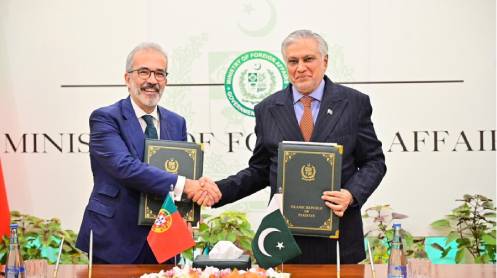
The two foreign ministers signed an agreement providing mutual exemption from visa requirements for holders of diplomatic passports.
According to Pakistan’s Foreign Office, the agreement will facilitate high-level engagement, diplomatic exchanges and strengthen longstanding friendly relations between Islamabad and Lisbon.
Dar expressed hope that the visa exemption arrangement could eventually be extended to holders of official and ordinary passports.
He also proposed a labour mobility partnership to create more legal employment opportunities for skilled Pakistani workers in Portugal. In this regard, he invited Portugal to consider Pakistan’s proposal and highlighted the potential of Portugal’s Green Path Mechanism to facilitate the recruitment of Pakistani professionals to meet workforce requirements.
The discussions also covered academic cooperation, research partnerships, cultural exchanges, tourism and people-to-people contacts.
President Zardari, PM Shehbaz Hold Meetings with Portuguese FM
During his visit, Rangel also met President Asif Ali Zardari at Aiwan-i-Sadr, where both sides discussed opportunities to broaden cooperation across several sectors.
President Zardari described Portugal as an important partner within the European Union and highlighted considerable potential for expanding bilateral trade and investment.
He stressed the need to diversify trade beyond traditional textile exports by exploring opportunities in agriculture, processed food, pharmaceuticals, engineering goods, sports products and information technology services.
The president proposed establishing a joint working group on trade and investment to address commercial barriers, identify new opportunities and facilitate business cooperation.
He also highlighted potential collaboration in renewable energy, education, research, technology and sports. In particular, he welcomed the partnership between Portuguese football club FC Porto and the Sialkot Football Academy, encouraging further cooperation through coaching exchanges, youth tournaments, training programmes and sports science.
President Zardari expressed hope for the early finalisation of a proposed memorandum of understanding on agricultural cooperation and the establishment of a bilateral technical working group.
He also appreciated Portugal’s support for Pakistan’s GSP+ status and sought continued cooperation for the welfare, consular access, integration and protection of the rights of the Pakistani community in Portugal.
Rangel described bilateral relations as excellent and said both countries should translate their political goodwill into stronger economic and cultural cooperation.
He noted that more than 60,000 Pakistanis were living in Portugal and contributing to its society, while over 600 Pakistani students were pursuing education there, with dozens benefiting from Portuguese scholarships.
The visiting minister also informed the president that Portugal’s agriculture minister would soon visit Pakistan to explore opportunities for cooperation in the agricultural sector.
Separately, Prime Minister Shehbaz Sharif met Rangel and welcomed Portugal’s acceptance of Pakistan’s proposal to establish a Joint Ministerial Commission.
The prime minister said the commission would provide a structured mechanism to identify shared priorities, strengthen institutional engagement and ensure follow-up on practical areas of cooperation.
Both leaders discussed expanding collaboration in trade, investment, agriculture, information technology, textiles, tourism, education and cultural exchanges. Particular attention was given to olive cultivation, agricultural processing, technology transfer and stronger institutional links between textile organisations in the two countries.
Shehbaz also encouraged Portuguese companies to explore Pakistan’s investment potential, particularly in renewable energy, agriculture, food processing, technology and tourism.
The prime minister appreciated Portugal’s recognition of Pakistan’s role in facilitating regional dialogue and its support for the continuation of Pakistan’s GSP+ status.
Both leaders welcomed the Pakistan-Portugal Business Forum and expressed their commitment to translating the visit into tangible economic and commercial outcomes.
Portugal Appreciates Pakistan’s Role in Regional Peace
During a joint press interaction with Dar, Rangel praised Pakistan’s diplomatic efforts in promoting regional peace, particularly its role in facilitating dialogue during the US-Iran conflict.
He said Pakistan’s mediation efforts had helped prevent the situation from becoming significantly worse and acknowledged the diplomatic outreach undertaken by Prime Minister Shehbaz Sharif and Deputy Prime Minister Ishaq Dar.
Rangel also appreciated Pakistan’s commitment to multilateralism, the United Nations Charter and international peacebuilding efforts.
He congratulated Portugal on its election to the UN Security Council for the 2027-28 term and expressed interest in maintaining close political consultations with Pakistan during its tenure.
The Portuguese minister said Lisbon valued Pakistan’s contribution to international diplomacy and wanted to strengthen cooperation within the United Nations and the European Union frameworks.
Dar, meanwhile, reiterated Pakistan’s commitment to peace and diplomacy, highlighting discussions on Palestine, Jammu and Kashmir and regional security. He stressed that Afghan territory must not be used for terrorist activities against any country, particularly Pakistan.
He also reiterated Pakistan’s position on the Indus Waters Treaty, describing India’s unilateral decision to hold the agreement in abeyance as a violation of international law.
Rangel further praised Pakistan’s constructive role in promoting regional stability and acknowledged the contribution of the Pakistani diaspora in strengthening relations between the two countries.
The Portuguese minister described his visit as highly productive and invited Dar to visit Lisbon, expressing confidence that the two countries could build a stronger and more forward-looking partnership on the foundation of their 77 years of diplomatic relations.
Story by Ameer Hamza