
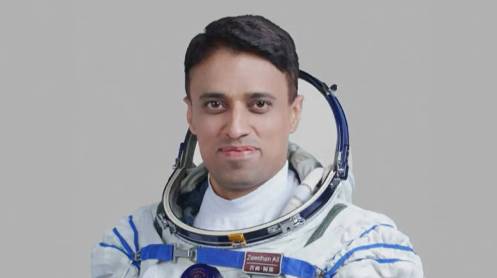
BEIJING: Pakistan is set to make history in space exploration as astronaut Mohammad Zeeshan Ali has been selected as a crew member of China’s Shenzhou-24 mission, becoming the first Pakistani to undertake an orbital spaceflight and the first foreign national to visit China’s Tiangong space station.
The China Manned Space Agency (CMSA) announced Ali’s selection on Tuesday, ahead of the mission’s scheduled launch on November 25 from the Jiuquan Satellite Launch Centre in northwest China.
CMSA spokesperson Zhang Jingbo confirmed that Ali would become the first foreign astronaut to visit the Tiangong space station, marking a significant milestone in Pakistan-China space cooperation.
According to the agency, Ali will serve as a payload specialist, joining Chinese astronauts Tang Hongbo, who will command the mission, and Wu Yi, who will serve as the mission pilot.
The crewed spacecraft is scheduled to launch at 8:18am Beijing time (5:18am Pakistan time). Ali is expected to spend approximately one week in orbit, conducting scientific experiments and other activities alongside the Chinese crew.
During the mission, the astronauts are expected to carry out around 90 experiments, perform routine maintenance and operational activities aboard the space station, and continue scientific research involving space-based payloads.
The mission will also involve an orbital crew rotation with astronauts currently stationed aboard Tiangong. After completing his assignment, Ali is expected to return to Earth aboard the Shenzhou-23 spacecraft, which docked with the space station in May.
Carrying the Hopes of 250 Million Pakistanis
Speaking at a press briefing in Jiayuguan, Ali expressed deep gratitude to the Chinese government for providing him with the opportunity to fulfil his dream of travelling into space.
He said he had arrived at the Astronaut Centre of China several months earlier, carrying the hopes and aspirations of approximately 250 million Pakistanis.
Ali described his training experience as exceeding his expectations, saying he had acquired essential spaceflight skills through comprehensive instruction provided by Chinese experts, scientists and instructors.
He also highlighted his experience of learning the Chinese language and developing close friendships with his Chinese crewmates.
“We trained side by side, and our friendship embodies the friendship between China and Pakistan: higher than the mountains, deeper than the oceans, sweeter than honey and as vast as outer space,” he said.
Ali said the mission represented not only a personal achievement but also a shared milestone for both countries, adding that the longstanding friendship between Pakistan and China was now extending beyond Earth into space.
“Now, this dream belongs to me and also belongs to Pakistan,” he said, expressing confidence that the Shenzhou-24 mission would open a new chapter in bilateral space cooperation.
He emphasised that the significance of the mission extended beyond the flight itself, saying it should serve as a starting point for broader collaboration, including future joint missions to the Moon, Mars and beyond.
“This mission is not a finish line; it is a launch pad,” Ali said, expressing hope that future cooperation would expand from a single astronaut and mission to multiple joint spaceflights.
A New Chapter in Pakistan-China Space Cooperation
Ali noted that 2026 marked the 75th anniversary of China-Pakistan diplomatic relations and highlighted the importance of the two countries’ longstanding partnership in advancing space exploration.
Addressing the people of Pakistan, he said he was not travelling into space for personal achievement but carrying the country’s name and the aspirations of its people.
“I carry the name of Pakistan on my shoulder, the hopes of 250 million Pakistanis,” he said.
He also delivered an emotional message to Pakistani children, encouraging them to look towards the sky and believe in their dreams.
“To every child who is watching while I am in orbit, just look up at the sky and remember that I am up there with your dreams,” he said.
Ali thanked his family, teammates, instructors, scientists, engineers, Pakistan’s Space and Upper Atmosphere Research Commission (Suparco) and the China Manned Space Agency for their support in making the mission possible.
He said the achievement demonstrated how cooperation between the two countries could turn ambitious goals into reality and send a message to the world about the peaceful use of outer space.
“We have already made history together,” he said.
Pakistan Leadership Welcomes Historic Achievement
Pakistan’s political leadership welcomed Ali’s selection, describing it as a landmark achievement for the country and a reflection of its close partnership with China.
Planning Minister Ahsan Iqbal congratulated the astronaut, saying the joint mission demonstrated the trust, cooperation and longstanding friendship between the two countries.
Information Minister Attaullah Tarar also expressed pride in the achievement, describing Pakistan’s first astronaut travelling into space as a moment of national joy and honour.
Earlier in April, Ali and fellow Pakistani astronaut Khurram Daud were selected to begin astronaut training in China.
Prime Minister Shehbaz Sharif met both candidates at the time and congratulated them on their selection, describing the mission as a matter of national pride. He also expressed hope that the initiative would add new dimensions to Pakistan-China relations.
The selection followed a cooperation agreement signed between Suparco and CMSA in February 2025, under which two Pakistani candidates would receive astronaut training in China, with one selected to participate in a mission aboard the Tiangong space station.
China Expands Its Global Space Cooperation
China has significantly expanded its space programme in recent years as it seeks to strengthen its position alongside the United States and other major spacefaring nations.
Beijing aims to send astronauts to the Moon by 2030 and has increasingly pursued international partnerships to support its expanding space ambitions.
Pakistan has emerged as an important partner in this effort, supported by decades of strategic cooperation and close diplomatic relations between the two countries.
China’s Tiangong space station has also become a platform for international cooperation, particularly as Beijing remains excluded from participation in the International Space Station programme following US restrictions on NASA’s collaboration with Chinese space agencies in 2011.
Ali’s participation in the Shenzhou-24 mission therefore represents a major milestone for Pakistan’s emerging human spaceflight programme and creates opportunities for further cooperation in scientific research, astronaut training and future space exploration.