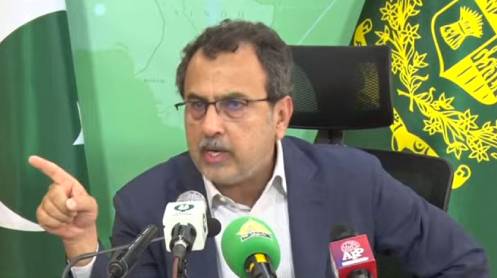
Islamabad, December 6 — Federal Minister for Power, Sardar Awais Ahmad Khan Leghari, announced an ambitious shift toward a fully digital, transparent, and consumer-centric power sector while addressing the Asia Energy Summit organized by LUMS University.
Leghari revealed that Pakistan aims to generate over 90% of its electricity from clean and green energy sources by 2035, a significant leap from the current 52% share of clean energy—a milestone he termed “historic.”
Pakistan Emerging as Asia’s Fastest-Growing Solar Market
The minister said Pakistan has already witnessed a ‘solar revolution,’ with citizens installing 50 gigawatts of solar panels independently, setting a global example of bottom-up energy transition.
He added that Pakistan has imported 17 GW of solar equipment, making it one of the fastest-expanding solar markets in Asia.
Why the Shift Matters
Leghari warned that while Pakistan contributes less than 1% to global emissions, it remains among the top 10 most climate-vulnerable countries. Asia as a whole is suffering annual climate losses exceeding $300 billion, he noted, emphasizing that energy transition is not only an environmental issue for Pakistan but “a matter of economic survival.”
Key Reforms Underway
Outlining the government’s plans, the power minister underscored a wide range of structural reforms:
- Privatization of DISCOs and significant reduction in circular debt as top priorities.
- Introduction of smart meters, ICT upgrades, and a move toward a modern smart grid.
- Deployment of the “Apna Meter, Apni Reading” mobile app to empower electricity consumers.
- Strengthening customer transparency through adopting 118 as the national power-sector helpline.
- Reorganization of NTDC to improve grid operations and project management.
- Technical capacity enhancement of DISCOs through PPMC.
- Solarization of tube wells in Balochistan to address both water and energy challenges.
Net Metering: Reforms Coming in Weeks
Leghari reaffirmed the government’s commitment to consumer-friendly net metering but stressed the need to ensure fairness across the system.
“Net-metering users are important, but 150,000 consumers cannot be allowed to become a burden on millions,” he said, confirming that new reforms will be introduced “within the next few weeks.”
Energy Pricing & Market Reforms
The minister disclosed that the government has already reduced industrial tariffs by Rs 16 per unit, though subsidy limitations remain due to IMF constraints.
He emphasized that Pakistan is now transitioning to a competitive energy market:
- The state will no longer purchase electricity directly.
- The CTBCM (Competitive Trading Bilateral Contract Market) policy has been forwarded for approval and will become operational in the first quarter of next year.
- The government is exploring multiple options to reduce capacity payments—currently a major burden in tariff determination.
Asia as the Global Energy Transition Hub
Leghari highlighted Asia’s pivotal role in global energy diplomacy, noting that 48% of the world’s energy consumption occurs in this region. He said Asia’s renewable energy investment has grown by 900%, placing it at the forefront of the global clean energy race.
How Pakistan Will Deliver
The minister said Pakistan’s energy transition strategy rests on three pillars:
- Decarbonization
- Digitization
- Decentralization
He added that previous governments lacked an integrated approach to power-sector planning, but the current administration has aligned generation and transmission planning for long-term sector stability.