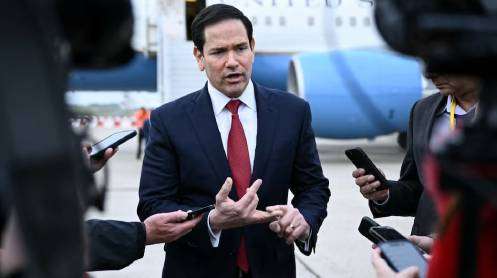
PARIS/WASHINGTON: US Secretary of State Marco Rubio has said the ongoing Gulf conflict is expected to conclude within weeks rather than months, emphasizing that Washington can achieve its objectives without deploying ground combat forces.
Speaking after a meeting with G7 counterparts in France, Rubio stated that the United States is “on or ahead of schedule” in its operations and anticipates wrapping up the conflict “in a matter of weeks, not months.”
While ruling out the necessity of a ground offensive, Rubio confirmed that limited troop deployments are underway to provide strategic flexibility. “We are positioning forces to give the President maximum optionality to respond to evolving contingencies,” he said.
The Pentagon has already dispatched thousands of Marines to the region, with additional elite airborne units expected to follow. The first contingent is set to arrive by the end of March aboard an amphibious assault ship.
These deployments have raised concerns that the conflict—already disrupting global energy markets—could escalate into a prolonged ground war. However, US President Donald Trump has highlighted ongoing diplomatic efforts, describing negotiations as “productive” despite Iran’s public denial of formal talks.
Rubio confirmed that Washington is awaiting a formal response from Iran to a 15-point proposal aimed at ending the conflict. The proposal, reportedly conveyed via Pakistan, includes demands related to Iran’s nuclear and missile programmes, as well as control over critical energy trade routes.
“There have been exchanges of messages and indications of willingness to engage,” Rubio noted, adding that clarity is still needed regarding the scope and participants of potential talks.
Earlier, President Trump extended a 10-day deadline for Iran to reopen the strategically vital Strait of Hormuz or face further attacks on its civilian energy infrastructure. Sources indicate that an Iranian counter-proposal may be forthcoming.
Despite public resistance, Iranian officials have acknowledged that communication channels remain open through third-party intermediaries.
Meanwhile, the conflict has intensified across the region, causing widespread casualties and severe economic repercussions. Strikes have reportedly targeted Iranian nuclear-related facilities, including a decommissioned heavy-water reactor and a uranium processing site, though no radiation leaks have been reported.
The war has already resulted in over 1,900 deaths and at least 20,000 injuries in Iran, according to international humanitarian sources. In Lebanon, escalating hostilities involving Hezbollah and Israeli forces have displaced a significant portion of the population.
US intelligence assessments suggest that approximately one-third of Iran’s missile arsenal has been neutralized so far, though the conflict continues with no immediate resolution in sight.
Gulf Arab states have urged Washington to ensure that any eventual agreement not only ends the war but also imposes lasting constraints on Iran’s missile and drone capabilities, while safeguarding global energy supplies from future disruptions.
By Reuters