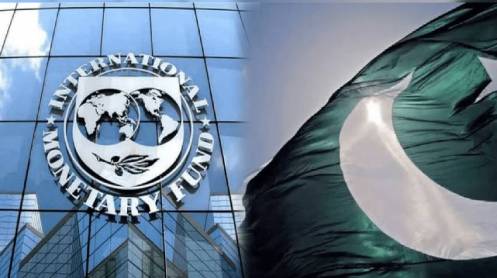
ISLAMABAD: The International Monetary Fund (IMF) has set Pakistan’s petroleum levy collection target at Rs1.73 trillion for fiscal year 2026-27, an increase of Rs259 billion over the current year, while also tightening conditions to ensure the Federal Board of Revenue (FBR) meets its revenue goals, according to the Fund’s staff-level report released on Friday.
The report revealed that the federal and provincial governments will jointly undertake additional revenue measures worth Rs860 billion. Of this amount, the federal government will generate Rs430 billion through new taxation and enforcement measures, while provinces will contribute the remaining share by expanding sales tax on services and improving agricultural income tax collection.
Pakistan’s federal budget for FY27 is projected to exceed Rs17.1 trillion, reflecting nearly 9 percent growth compared to the revised budget estimates for the current fiscal year. The defence allocation is expected to rise to Rs2.665 trillion, an increase of Rs101 billion.
The IMF has set the petroleum levy target for FY27 at Rs1.727 trillion, up 17.6 percent from this year’s target. Analysts believe achieving this ambitious target may prove difficult as rising fuel prices could suppress consumption. At present, the government charges approximately Rs117.4 per litre petroleum levy on petrol and nearly Rs43 per litre on diesel.
The IMF noted that petroleum products in Pakistan currently carry an effective tax rate of 166 percent, making government revenues heavily dependent on fuel taxation and vulnerable to external shocks.
Pakistan has also agreed to impose additional taxes worth Rs215 billion and raise another Rs215 billion through enhanced audit systems, production monitoring, and enforcement measures under the FBR’s transformation plan.
In a significant development, the IMF has converted the FBR’s revenue target into a quantitative performance criterion instead of an indicative benchmark. Failure to meet the agreed targets will now require a formal waiver from the IMF Executive Board — a stricter condition accepted by Pakistan after the FBR missed targets for two consecutive years.
According to the agreement, the government aims to collect Rs7.022 trillion in revenue by December 2026, while the full-year FBR target for June 2027 has been fixed at Rs15.27 trillion, requiring nearly 14 percent growth over the expected collection for the current fiscal year.
The government has assured the IMF that any tax relief measures introduced in the FY27 budget will be offset through new permanent taxation policies to avoid revenue losses.
Provincial governments have also committed to increasing tax revenues by broadening the scope of General Sales Tax (GST) on services and implementing agricultural income tax reforms from FY2026 agricultural earnings onward.
The IMF highlighted Pakistan’s narrow tax base as a major structural weakness, noting that despite contributing 24.6 percent to the economy’s value addition, the agricultural sector’s effective tax rate remains only 0.3 percent due to weak enforcement and implementation delays.
The report further observed that although Pakistan’s standard GST rate of 18 percent is comparatively high in the region, only about one-quarter of the potential tax base is effectively taxed because of widespread exemptions and concessional rates. To improve sales tax efficiency to regional standards, Pakistan would need to generate an additional Rs2.1 trillion through GST reforms.
The IMF also warned that a prolonged Middle East conflict could negatively impact Pakistan’s economic outlook by disrupting remittance flows, increasing oil prices, reducing access to short-term commercial financing from Gulf banks, and triggering capital outflows.
The lender revised Pakistan’s economic growth outlook downward for FY27 due to higher global commodity prices and weak external demand. Under an adverse scenario, economic growth could fall to just 2.6 percent, while inflation may accelerate to nearly 10 percent next fiscal year.
Consumer Price Index (CPI) inflation is expected to exceed 10 percent in the fourth quarter of the current fiscal year and average 8.4 percent in FY27 before returning to the State Bank of Pakistan target range in FY28.
The IMF has also ruled out broad fuel subsidies, linking the release of $1.3 billion in loan tranches to full recovery of petroleum prices and taxes.
As a net importer of oil and gas, Pakistan sources nearly 81 percent of its fuel imports from Gulf countries. The IMF warned that any prolonged disruption in fuel supplies through the Gulf region could severely impact economic activity and worsen the current account deficit.
The report added that while Pakistan remains largely self-sufficient in urea production, disruptions in DAP fertiliser imports could affect the upcoming Kharif crop season. It also cautioned that any economic slowdown in Gulf countries could reduce remittance inflows, which account for nearly 55 percent of Pakistan’s foreign remittances.
Despite these challenges, the IMF maintained that Pakistan’s public debt remains sustainable over the medium term, although significant risks persist due to high financing requirements and difficulties in securing quality external investment and financing.
Story by Shahbaz Rana