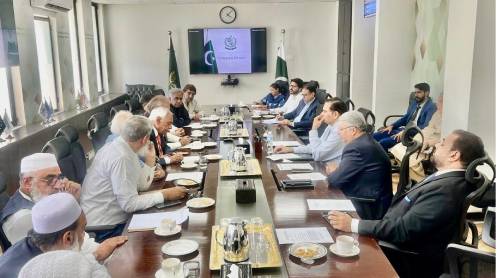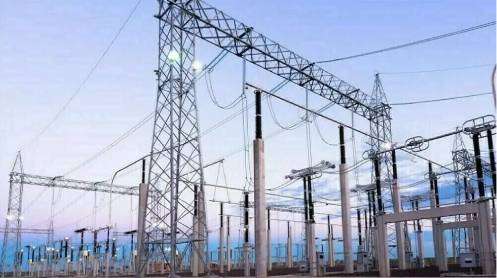
ISLAMABAD: Federal Minister for Power Sardar Awais Ahmad Khan Leghari has reviewed the progress of a proposed 40 MW power generation project aimed at strengthening electricity supply for Gwadar and supporting the city’s growing energy needs.
The project envisages the development of a power plant with a firm and dependable capacity of approximately 40 MW for a period of 15 years. The scope includes financing, installation, testing, commissioning, ownership, operation, and maintenance of the facility through a competitive bidding process.
Key project features
- Generation capacity: approximately 40 MW.
- Project term: 15 years.
- Scope: financing, installation, commissioning, operation, and maintenance.
- Procurement: competitive bidding among pre-qualified firms.
According to official details, bidders will have flexibility in technology selection and may propose thermal, hybrid, or renewable-plus-thermal solutions, provided they meet prescribed technical, environmental, performance, and Grid Code requirements. Both new and refurbished equipment may be used, subject to standards that will be specified in the Request for Proposals (RFP).
The successful bidder will supply electricity to Quetta Electric Supply Company (Qesco) under a Power Purchase Agreement (PPA), with tariffs determined through competitive bidding and approved by the National Electric Power Regulatory Authority (Nepra).
Strategic importance of Gwadar
Officials noted that the RFP will be issued only to pre-qualified applicants to ensure participation by technically and financially capable bidders.
Gwadar is considered a strategically important city for Pakistan’s long-term economic development, particularly under the China-Pakistan Economic Corridor (CPEC) initiative. The city is being developed as a major maritime, logistics, and industrial hub, and ongoing expansion of port infrastructure, industrial zones, and urban development projects is expected to significantly increase electricity demand.
Why this matters
- Supports Gwadar’s expansion as a maritime and logistics hub.
- Helps meet rising electricity demand from industrial zones and urban development.
- Reduces reliance on imported power over time.
At present, Gwadar relies heavily on imported electricity from Iran through cross-border interconnections at Pishin and Polan, each having a capacity of 100 MW. The Polan interconnection primarily serves Gwadar due to its proximity, while the Pishin link supplies other parts of the Makran region.
The proposed project is expected to improve energy security for Gwadar and support future industrial and commercial growth in the region.
Story By Mushtaq Ghumman