Karachi: Global oil markets reacted positively to reports of an emerging peace agreement between the United States and Iran, with crude oil prices falling sharply during trading in Asian markets amid expectations of improved energy supply flows and easing geopolitical tensions in the Middle East.
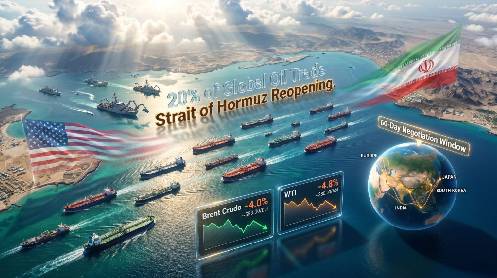
Brent crude futures dropped by 3.8 percent to $84.02 per barrel, while US West Texas Intermediate (WTI) crude declined by 4.1 percent to $81.40 per barrel following reports that Washington and Tehran have reached a framework for a peace agreement aimed at ending months of conflict and restoring maritime trade routes.
According to media reports, the formal signing ceremony is expected to take place in Switzerland on Friday. US President Donald Trump has also indicated progress toward an agreement, stating on social media that the free movement of oil through international waterways would continue under the proposed arrangement.
Strait of Hormuz at the Center of Global Energy Security
The anticipated agreement is expected to pave the way for the reopening of the Strait of Hormuz, one of the world’s most critical energy chokepoints through which nearly 20 percent of global oil and gas supplies transit.
The waterway was effectively closed following military hostilities that erupted on February 28 after US and Israeli air strikes on Iran. The disruption triggered a sharp rise in global oil prices and heightened concerns over energy security, shipping costs, and inflationary pressures worldwide.
Industry analysts believe that any progress toward restoring navigation through the Strait of Hormuz will be welcomed by global energy markets, shipping companies, and importing nations that have faced uncertainty over fuel supplies in recent months.
Maritime Blockade and Economic Impact
Iranian state media reported that one of the key provisions of the peace agreement includes the lifting of the US naval blockade on Iranian ports within 30 days. The blockade, imposed after the escalation of hostilities, significantly disrupted Iran’s trade and energy exports.
According to the US Central Command (CENTCOM), since the blockade intensified in April, nine vessels have been disabled while more than 135 ships were forced to alter their routes, highlighting the severe impact on regional maritime traffic.
Economic observers note that the restrictions have imposed substantial costs on Iran’s economy, while simultaneously affecting global shipping routes and energy supply chains.
Long-Term Questions Remain
While markets have welcomed the prospect of de-escalation, experts caution that the true measure of success will depend on whether the agreement delivers lasting regional stability and addresses concerns surrounding Iran’s nuclear ambitions.
Before the conflict, oil, liquefied natural gas (LNG), fertilizers, helium, and other commodities moved freely through the Strait of Hormuz. Restoring those flows would help reverse the economic damage caused by the conflict, but longer-term questions regarding regional security and nuclear proliferation remain unresolved.
Energy market analysts suggest that sustained peace and the normalization of maritime trade could provide relief to global energy markets, support lower fuel prices, and reduce volatility that has characterized the sector throughout the conflict.
Positive Outlook for Energy Markets
For energy-importing countries such as Pakistan, a sustained decline in international oil prices could help ease pressure on fuel import bills, inflation, and electricity generation costs. The potential reopening of the Strait of Hormuz is therefore being closely monitored by governments, energy companies, and investors worldwide.
As negotiations move toward formal ratification, global markets are expected to remain focused on developments surrounding the implementation of the agreement and the restoration of normal energy trade flows across the Gulf region.