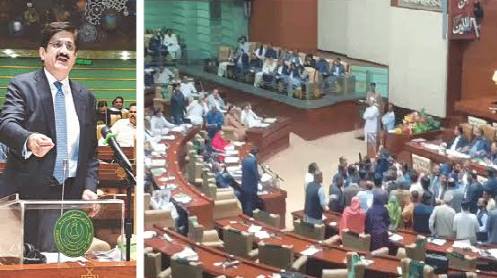
KARACHI: The Sindh government on Wednesday presented a tax-free budget of Rs3.562 trillion for fiscal year 2026-27, with a projected deficit of Rs36.9 billion, while focusing on development, social welfare, infrastructure, and public relief measures.
Presenting the budget in the Sindh Assembly, Chief Minister Murad Ali Shah, who also holds the finance portfolio, described it as a budget of “hope, development, and public trust,” aimed at balancing fiscal discipline with the welfare needs of citizens amid inflationary pressures, rising fuel costs, global economic uncertainty, and ongoing flood recovery efforts.
The budget estimates total receipts at Rs3.525 trillion against expenditures of Rs3.562 trillion, resulting in a deficit of Rs36.9 billion.
Development Spending Adjusted
The chief minister revealed that Sindh’s development outlay had been revised downward from an initially projected Rs575 billion to Rs400 billion following the province’s contribution toward national strategic requirements under an agreement with the federal government.
Despite fiscal constraints, he said the government had safeguarded priority development projects and essential public services. The arrangement with the Centre, backed by a memorandum of understanding, protects Sindh’s constitutional share under the 7th NFC Award through a guaranteed federal revenue assignment base of Rs13.35 trillion.
Major Development Allocations
Under the Annual Development Programme (ADP), significant allocations have been earmarked for key sectors, including:
- Rs121.66 billion for local government, water, sanitation, roads, and mega projects
- Rs40.86 billion for public health engineering and rural development
- Rs39.54 billion for transport and communication
- Rs30.94 billion for irrigation projects
- Rs25.86 billion for education
- Rs17.43 billion for health services
- Rs6.3 billion for agriculture and livestock development
No New Taxes, Relief Measures Announced
The Sindh government announced that no new taxes would be imposed in the upcoming fiscal year.
To provide relief to citizens, the government has approved a 7 percent increase in salaries and pensions, effective from July 2026, through the integration of ad hoc relief allowances into basic pay. The minimum monthly wage has also been raised from Rs40,000 to Rs43,000.
Additional relief measures include:
- Reduction of sales tax on education support services to 5 percent
- Continuation of the 5 percent tax rate on overseas employment recruitment services for another two years
- Lower tax rates for insurance agents and brokers
- Increase in the agriculture income super tax exemption threshold from Rs150 million to Rs500 million
- Reduction in the agriculture super tax rate from 10 percent to 8 percent
Social Welfare and Flood Recovery
The government has allocated Rs13.3 billion for social protection initiatives under its pro-poor portfolio, including the Sindh Peoples Support Programme, Benazir Hari Card, housing schemes, assistance for widows and orphans, support for persons with disabilities, SME financing, livestock distribution, and women agricultural workers’ empowerment.
The budget also continues support for flood recovery and housing reconstruction efforts. According to the government, more than one million houses have been completed, while construction work is underway on over 1.6 million housing units.
Rs100 Billion Allocated for Karachi Projects
Declaring Karachi the province’s economic engine, CM Murad Ali Shah announced Rs100.19 billion for development projects in the metropolis. Karachi’s overall development portfolio comprises 816 schemes with a cumulative cost of Rs644.3 billion.
Key projects include:
- Rs1.2 billion flyover from Airport Road to Star Gate
- Rs1.5 billion Malir Halt–Shahrah-e-Faisal underpass
- Rs1.65 billion Sir Shah Suleman Road flyover over Gujjar Nullah
- Development of Shahrah-e-Bhutto-Korangi Causeway junction and Malir Expressway interchanges
- Water supply, municipal infrastructure, road networks, and urban reforms
Focus on Green Transport
The provincial government has also accelerated investments in public transportation, including the expansion of the People’s Bus Service, induction of electric minibuses and double-decker buses, and plans to procure 500 additional electric buses.
Furthermore, Rs13.2 billion has been allocated for the Red Line BRT project and more than Rs3.5 billion for the Yellow Line BRT.
Concluding his budget speech, the chief minister reaffirmed the government’s commitment to completing ongoing development projects, strengthening public services, and maintaining support for health, education, agriculture, social protection, transport, and urban infrastructure despite ongoing fiscal challenges.
Story by Tahir Siddiqui