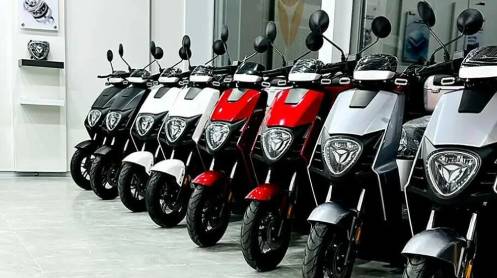
KARACHI: Demand for electric motorcycles is steadily increasing in Karachi as commuters seek relief from rising fuel prices and lower maintenance costs. However, the city’s deteriorating road infrastructure continues to hinder wider adoption, according to industry stakeholders.
The number of electric motorcycle dealerships has expanded significantly across Karachi, particularly on Akbar Road, the city’s largest motorcycle market. Despite the growing interest, dealers say supply remains limited as manufacturers continue to prioritise deliveries to Punjab, where demand is considerably higher and road conditions are more favourable.
Auto and motorcycle analyst and Akbar Road dealer Muhammad Sabir Shaikh told Business Recorder that demand for electric motorcycles has outpaced supply, with assemblers focusing on cities such as Lahore, Faisalabad, Islamabad, Rawalpindi, Gujranwala, Sahiwal and Gujrat, where demand is estimated to be nearly three times greater than in Karachi.
He said Karachi now has more than 25 EV showrooms on Akbar Road and around 200 dealerships citywide, with most leading brands operating between three and six outlets. Despite this expansion, Karachi ranks only fifth or sixth nationwide in EV adoption, largely due to poor road conditions compared to Punjab.
Shaikh added that 75 assemblers have applied for Engineering Development Board (EDB) production certificates, while more than 60 have already received approvals, with others currently under review.
VLEKTRA Founder and CEO Syed Raza Mohsin said the increasing number of EV dealerships reflects strong market potential.
“A petrol motorcycle owner spends a significant portion of their monthly income on fuel. With rising petrol prices, switching to electric drastically reduces operating costs. Maintenance is also much lower, as EVs do not require oil changes, clutches or exhaust system repairs,” he said.
However, Mohsin noted that Lahore and other Punjab cities remain ahead of Karachi in EV adoption due to superior road infrastructure.
He described Karachi’s deteriorating roads as one of the biggest obstacles to the transition towards electric mobility, stressing the need for sustained government investment in road rehabilitation and improved drainage systems.
“This requires a long-term infrastructure commitment, not a one-time announcement,” he said.
Mohsin welcomed the Sindh government’s Pink Bike Distribution Programme, launched through the Sindh Mass Transit Authority to provide subsidised electric scooters to women, and suggested further incentives such as reducing or waiving registration and token taxes for electric vehicles.
He also highlighted VLEKTRA’s localisation strategy, stating that the company is working to manufacture batteries and motors domestically by 2027, reducing dependence on imports and shielding consumers from currency fluctuations.
Addressing concerns over resale value, Mohsin said the company has introduced a buyback programme, allowing customers to sell their electric motorcycles back to the company at a pre-determined value adjusted for normal wear and tear.
“The programme removes uncertainty for buyers and makes it easier for customers to upgrade to newer models as the market matures,” he added.
Story by Gohar Ali Khan