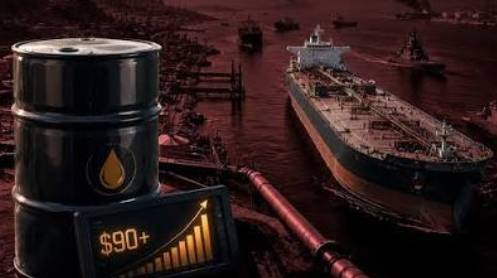
SINGAPORE: Global oil prices surged on Monday, with Brent crude climbing above $90 per barrel for the first time in more than a month, as intensifying military exchanges between the United States and Iran raised concerns over disruptions to oil shipments through the strategic Strait of Hormuz.
Brent crude futures rose $2.09, or 2.37%, to $90.19 per barrel by 0241 GMT, touching their highest level since June 11 after posting a 15.9% gain last week—the largest weekly increase since April.
Meanwhile, US West Texas Intermediate (WTI) crude advanced $1.71, or 2.07%, to $84.20 per barrel, reaching its highest level since June 12. WTI prices gained 15.5% last week, marking their strongest weekly performance since early March.
The latest rally comes as tensions in the Middle East continue to escalate. Over the weekend, the United States reportedly carried out a ninth consecutive night of strikes against Iran, while US allies Kuwait and Bahrain also reported Iranian attacks.
Analysts at ING said the continued escalation has significantly increased market concerns.
“ICE Brent broke above $90 per barrel this morning with no let-up in the escalation in the Gulf. The US and Iran continue to exchange strikes, which are proving deadly for both sides. If this escalation goes unchecked, we could return to an environment of widespread attacks across the Gulf,” the analysts said.
The Islamic Revolutionary Guard Corps (IRGC) claimed that two oil tankers exploded and became immobilised while attempting to transit what it described as an unsafe southern route through the Strait of Hormuz, alleging the vessels had been encouraged by the US military to use the passage. However, Reuters could not independently verify the claim.
Shipping security has deteriorated in recent days, with both Washington and Tehran targeting maritime traffic. The US says it is enforcing a naval blockade on Iranian ports, while Iran has warned it is taking action against vessels it says violate its navigation rules in the Strait of Hormuz.
The United Kingdom Maritime Trade Operations (UKMTO) also reported that a vessel caught fire northwest of Kumzar, Oman, early Monday, further underscoring the heightened security risks in the region.
Barclays analyst Amarpreet Singh said the coming weeks would determine how significantly the renewed maritime disruptions affect regional oil exports.
“The coming days and weeks will provide a clearer picture of the sustainable level of oil exports from the region under renewed dual blockades. Oil markets remain too complacent about the potential impact on inventories, which are currently at their tightest levels in the past five years,” he said.
According to LSEG shipping data, only four vessels transited the Strait of Hormuz on Sunday, compared with eight the previous day, highlighting the growing disruption to one of the world’s most critical energy chokepoints. At least three oil products tankers and one Very Large Crude Carrier (VLCC) have entered the strait since Friday to load crude and refined products.
By Reuters