ISLAMABAD: Pakistan and Kyrgyzstan on Thursday agreed to raise bilateral trade to $200 million by 2027-28, setting an ambitious new benchmark as both countries push to deepen economic, energy, and strategic cooperation.
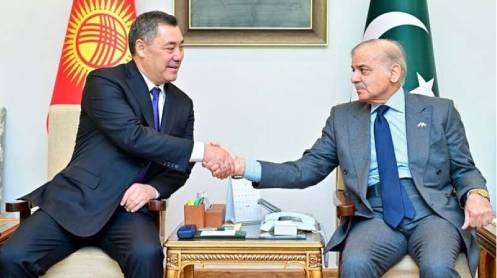
The commitment came during high-level talks between Prime Minister Shehbaz Sharif and Kyrgyz President Sadyr Zhaparov in Islamabad. Senior officials—including Foreign Minister Ishaq Dar and Chief of Army Staff & Field Marshal Gen Syed Asim Munir—were present for the discussions, which focused on accelerating cooperation across trade, connectivity, energy and security.
Prime Minister Sharif said the enhanced trade goal aligns with Pakistan’s broader “Vision Central Asia” policy to strengthen ties with the region. Both leaders agreed to adopt a results-driven approach, ensuring timely execution of all agreements and MoUs.
Energy and Connectivity Take Center Stage
A major focal point of the dialogue was the CASA-1000 regional power project, which aims to transmit surplus electricity from Central Asia to South Asia. Both leaders stressed the urgent need for its timely completion, calling it vital for regional energy security and long-term integration.
Connectivity was another top priority. The two sides discussed operationalising the Quadrilateral Traffic in Transit Agreement (QTTA) to enhance road links and reduce trade barriers, emphasizing the importance of secure and diversified transport corridors.
Progress in Multiple Sectors
The leaders reviewed progress from the 5th Kyrgyz-Pakistan Joint Intergovernmental Commission and expressed satisfaction with developments in education, agriculture, tourism and people-to-people exchanges.
Regional security issues, including instability in Afghanistan, were also discussed. Both sides urged the Afghan Taliban to meet international obligations—particularly regarding counterterrorism—to address Pakistan’s security concerns.
On global matters, Pakistan and Kyrgyzstan reaffirmed support for Palestine, backing the creation of an independent state based on pre-1967 borders with East Jerusalem as its capital.
15 MoUs Signed Across Strategic Sectors
The visit concluded with the signing of 15 agreements and MoUs, covering energy, trade, agriculture, education, culture, tourism, customs cooperation and the exchange of convicted persons. Key agreements included:
- MoU between Pakistan’s Foreign Service Academy and Kyrgyzstan’s Diplomatic Academy
- Trade cooperation pact between Pakistan’s Ministry of Commerce and Kyrgyzstan’s Ministry of Economy and Commerce
- Bilateral energy cooperation agreement
- Agreements on electronic customs data exchange, tourism promotion, cultural cooperation, and surgical instruments collaboration
A landmark development was the decision to establish sister city relations between Islamabad and Bishkek, aimed at deepening diplomatic and cultural ties.
The agreements marked a significant step toward advancing Pakistan-Kyrgyzstan relations, with both countries pledging sustained high-level engagement to meet their shared economic and strategic goals.
Story by Zulfiqar Ahmed