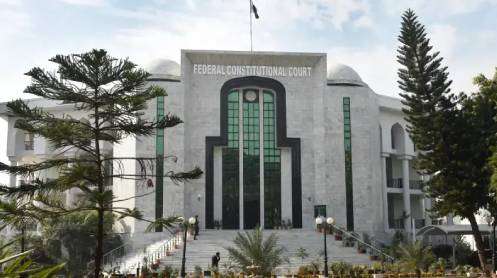
Islamabad: In a landmark constitutional and fiscal verdict, the Federal Constitutional Court (FCC) on Tuesday upheld the legality of the super tax and set aside earlier judgements of the high courts that had struck down or diluted the levy, declaring that Parliament has exclusive authority to impose taxes.
Thank you for reading this post, don't forget to subscribe!Announcing its short order, a three-member FCC bench headed by Chief Justice Aminuddin Khan, and comprising Justice Syed Hasan Azhar Rizvi and Justice Syed Arshad Hussain Shah, ruled that Sections 4-B and 4-C of the Income Tax Ordinance (ITO) 2001 are intra vires of the Constitution and shall apply from the dates they were originally imposed at the prescribed rates. The detailed judgement will be issued later.
The ruling follows 71 hearings initially conducted by the Supreme Court before the cases were transferred to the FCC after the 27th Constitutional Amendment. The judgement resolves more than 2,200 long-pending tax cases, safeguarding an estimated Rs310 billion in public revenue, according to senior counsel representing the Revenue Division.
Background of the Super Tax
The super tax was first introduced in 2015 through a money bill by the PML-N government as a one-time levy to fund the rehabilitation of areas affected by Operation Zarb-i-Azb. Initially, an additional 5 per cent tax was imposed on annual profits exceeding Rs300 million.
In 2022, the scope of the super tax was expanded to include individuals earning over Rs150 million annually, with rates going up to 10 per cent. The tax applies to wealthy individuals, associations of persons and companies, with a 4 per cent rate for banking companies and 3 per cent for other sectors.
High Courts’ Verdicts Set Aside
The FCC ruled that the Sindh, Lahore and Islamabad High Courts had exceeded their jurisdiction by striking down or reinterpreting Section 4-C. The court held that judicial review does not extend to re-determining tax slabs, rates, thresholds or fiscal policy, terming such actions a violation of the doctrine of separation of powers.
All appeals filed by the Federal Board of Revenue (FBR), the Secretary Revenue Division, and the Commissioner Inland Revenue were declared maintainable.
Energy Sector Gets Partial Relief
Significantly for the energy and petroleum sector, the FCC allowed oil and gas exploration companies to seek exemptions on a case-by-case basis under the 1948 petroleum concessions regime. The court acknowledged that taxes imposed beyond the ceilings agreed in presidential petroleum concessions could expose Pakistan to international arbitration, a risk highlighted during the hearings with references to past disputes such as Reko Diq and rental power projects.
Senior legal sources noted that the petroleum sector was the only industry to receive conditional relief, as petroleum concession agreements carry sovereign guarantees. Industry representatives had warned that unilateral changes in tax terms could trigger arbitration proceedings and potential financial liabilities for the state.
Economic Impact Concerns
Commenting on the wider implications, senior counsel Isaac Ali Qazi cautioned that industries may respond by freezing production or sales to stay below the super tax threshold or passing on the tax burden to consumers, potentially adding to inflationary pressures.
The FCC’s ruling brings long-awaited clarity on the super tax regime, strengthening the government’s fiscal authority while offering limited but critical relief to the energy sector, particularly oil and gas exploration companies operating under international concession agreements.
Story by Nasir Iqbal