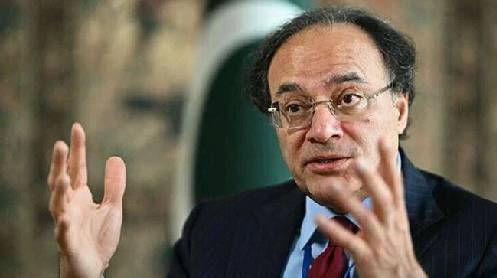
ISLAMABAD: Muhammad Aurangzeb, Federal Minister for Finance and Revenue, has revealed that Pakistan spends nearly one-fourth of its total import bill on petroleum products, underscoring the country’s continued dependence on imported energy.
Thank you for reading this post, don't forget to subscribe!In a written reply submitted during the National Assembly’s Question Hour on Friday, the minister stated that petroleum imports accounted for 22.2 percent of the country’s total imports during July–March of fiscal year 2025-26, making Pakistan’s external account highly sensitive to fluctuations in global oil prices.
Aurangzeb informed the House that the government collected Rs1.342 trillion through petroleum levy during the period from July 2025 to April 2026.
Despite volatility in international oil markets, he said Pakistan’s external sector performance has remained stable. During the first nine months of FY2026, the country recorded a current account surplus of $8 million, supported by an 8.2 percent increase in workers’ remittances, which reached $30.3 billion.
The minister also highlighted the strong performance of Pakistan’s IT sector, stating that IT exports rose by 19.8 percent to $3.4 billion during the same period.
According to Aurangzeb, the current account posted a significant surplus of $1.1 billion in March 2026 alone, even as average Brent crude oil prices climbed to $103.7 per barrel during the month.
He said the latest external sector position remains broadly aligned with the framework approved by the National Economic Council (NEC) under the Annual Plan 2025-26.
The Annual Plan projects a manageable current account deficit of approximately $2.1 billion, equivalent to 0.5 percent of GDP, while remittances are expected to reach around $39.4 billion by the end of FY2026.
Aurangzeb further noted that Pakistan’s foreign exchange reserves remain at a comfortable level. As of April 30, 2026, the country’s reserves stood at $21.3 billion.
He added that Pakistan recently received additional deposits worth $3 billion from Saudi Arabia, alongside an extension in the tenure of the earlier $5 billion deposits. The government has also successfully raised funds through Eurobond issuance in international markets.
The finance minister said the International Monetary Fund (IMF) Extended Fund Facility (EFF) programme remains on track, helping strengthen Pakistan’s external buffers against potential economic pressures arising from prolonged tensions in the Middle East.
However, Aurangzeb cautioned that downside risks persist amid the evolving geopolitical situation in the region. He said that while the impact of the ongoing Middle East crisis has so far remained contained, prolonged instability could alter Pakistan’s external outlook.
He added that if the situation worsens significantly, economic projections would be reassessed during the upcoming meetings of the Annual Plan Coordination Committee (APCC) and the NEC ahead of the FY2026-27 federal budget.
Story by Naveed Butt