ABU DHABI: The United Arab Emirates will accelerate construction of a major oil pipeline project aimed at doubling export capacity through Fujairah by 2027, significantly strengthening its ability to bypass the Strait of Hormuz amid ongoing regional tensions, according to the government’s Abu Dhabi Media Office (ADMO).
Thank you for reading this post, don't forget to subscribe!The announcement said Abu Dhabi Crown Prince Sheikh Khaled bin Mohamed bin Zayed Al Nahyan has directed the Abu Dhabi National Oil Company (ADNOC) to fast-track the West-East Pipeline project, which is already under construction and expected to become operational in 2027.
The development comes as the Strait of Hormuz remains severely disrupted following heightened regional conflict, which has pushed up global energy prices and raised concerns over supply security. The waterway is a critical route for a significant share of global oil shipments, and any disruption has immediate implications for international markets.
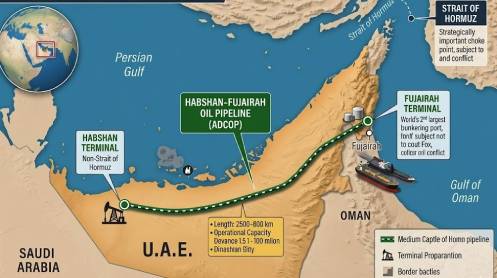
The UAE already operates the Abu Dhabi Crude Oil Pipeline (ADCOP), also known as the Habshan–Fujairah pipeline, which can transport up to 1.8 million barrels per day from inland oil fields directly to the Gulf of Oman, bypassing the strategic chokepoint.
Officials said the new expansion will further enhance export resilience by increasing the country’s ability to move crude oil outside the Strait of Hormuz. The move is part of broader efforts by Gulf producers to secure alternative export routes amid rising geopolitical risks.
Alongside the UAE, only a limited number of Gulf countries have pipeline routes that bypass the Strait, making such infrastructure increasingly vital for energy security. Saudi Arabia operates its East–West pipeline, which also provides a critical export route to the Red Sea.
The UAE’s broader energy strategy continues to focus on expanding production capacity and export flexibility, with ADNOC targeting up to 5 million barrels per day in capacity by next year. The country has also indicated potential production expansion to 6 million barrels per day if required.
The accelerated pipeline development reflects growing concerns among Gulf energy exporters about shipping vulnerabilities through the Strait of Hormuz, where recent tensions have disrupted trade flows and increased reliance on alternative routes such as Fujairah.
Energy analysts say the expansion underscores a wider regional shift toward building redundancy in export infrastructure, as Gulf producers seek to safeguard revenues and maintain supply stability amid persistent geopolitical uncertainty.
By Reuters