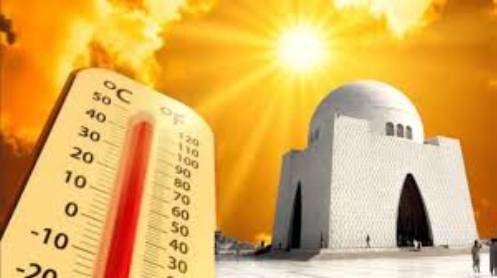
KARACHI: Karachi experienced intense heat conditions on Wednesday, with the “feels-like” temperature soaring to 54°C, despite the maximum recorded air temperature reaching 37.4°C, according to Pakistan Meteorological Department data.
The heat index rose sharply during the day, climbing from 49°C around 1pm to 54°C by 3pm, driven by high humidity levels. Relative humidity was recorded at 79% in the morning and 65% in the evening, while the minimum temperature stood at 30°C.
Other parts of Sindh also faced severe weather conditions, with Jacobabad recording 49.5°C, followed by Dadu at 49°C, Padidan and Sukkur at 47°C, Mohenjo Daro, Larkana, and Shaheed Benazirabad at 46.5°C, Rohri at 46°C, and Khairpur and Sakrand at 45–45.5°C.
Chief Meteorologist Ameer Hyder Laghari said relief is expected after Friday as a high-pressure system over the region gradually weakens, leading to a drop in temperatures to around 34–36°C in Karachi. However, he noted that no rainfall is expected in the coming days.
He also pointed out that Karachi’s highest recorded temperature for June stands at 47°C, recorded on June 18, 1979.
Medical experts have urged the public to take extreme precautions amid the heatwave. Dr Nadeemullah Khan, Professor and Chair of Emergency Medicine at Aga Khan University Hospital, emphasized that hydration is the most critical preventive measure.
He warned against consuming sugary drinks, caffeine, tea, coffee, and alcohol, as they can accelerate dehydration. He advised avoiding outdoor exposure during peak heat hours and recommended the use of air-conditioned or properly cooled environments, stating that fans alone are not sufficient when ambient temperatures exceed body temperature.
Dr Khan further noted that workers, especially those in heavy physical labor, should be provided with adequate water, shade, and rest breaks, while new or returning workers require gradual acclimatization. Elderly workers, he added, should not be assigned strenuous tasks during extreme heat.
He highlighted that children and the elderly are the most vulnerable groups during heatwaves. Children, due to faster heat absorption and limited thermoregulation capacity, should avoid outdoor activities during peak hours and never be left inside parked vehicles, where temperatures can become fatal within minutes.
For older adults, reduced cardiovascular capacity, limited mobility, and lack of adequate cooling facilities significantly increase health risks. Experts recommend regular family or community welfare checks to ensure their safety during prolonged heatwaves.
Health professionals continue to advise strict precautions as Pakistan faces increasingly severe summer conditions.
Story by Faiza Ilyas